bupt.ai Research & perspectives

AIDC RESEARCH

Computing Research Frontiers.

Research connecting computing, power and thermal management

DAILY RESEARCH EDITIONCooling · Compute–power coordination · AI infrastructure

In focus/ Research highlights

8 papers3 research areas

Cooling & thermal management/ In focus

Nanofluidic osmotic generator enhanced by data center waste heat recovery through hybrid water–air cooling with a heat pump

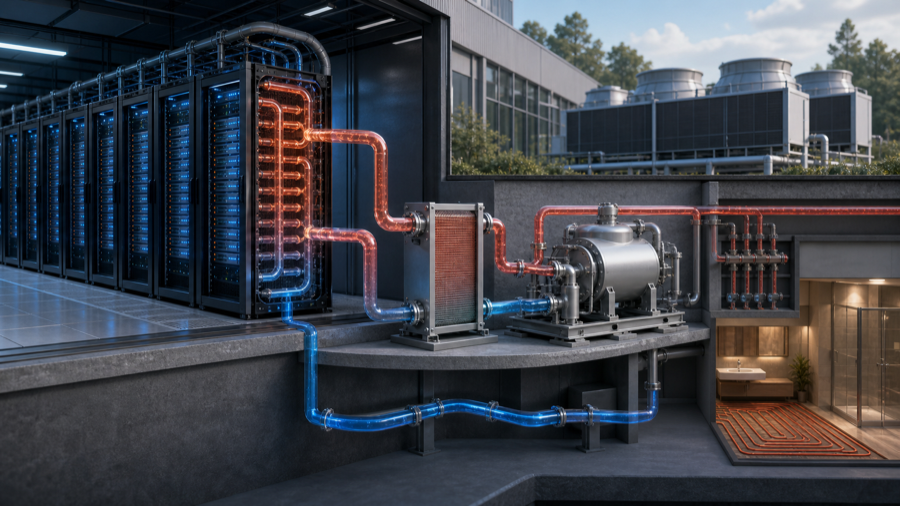
With the rapid development of artificial intelligence technology, data centers have become essential for offering computational resources. However, data centers suffer from the challenge of overheating, with a large amount of wasted low-grade thermal energy. In addition, nanofluidic osmotic generators face the drawback of a relatively low power output. Hence, the present work proposes a three-stage coupled energy utilization scheme, leveraging the temperature-sensitive characteristics of nanofluidic osmotic generators via thermal management of a data center. A hybrid water–air cooling strategy is applied to cool down server chips, and the recovered low-grade thermal energy is upgraded using an air-source heat pump (ASHP) to generate hot water, which serves as freshwater in a nanofluidic osmotic generator to enhance its power density. When the inlet velocity of the cooling water is 0.08 m s−1 and the inlet air velocity is 4 m s−1, the theoretical operating temperature of the server component in the data center is consistently maintained below 45.53 °C. Moreover, the cooling water from the data center is further heated by an ASHP to 56.78 °C for osmotic energy conversion. Under these circumstances, the power density of the nanofluidic osmotic generator is experimentally improved from 2.674 W m−2 to 4.895 W m−2 (i.e. by 83.06%) through thermal energy recovery from the data center under a 50-fold salinity-gradient ratio at neutral pH of 7, and it can be further enhanced to 5.443 W m−2 by modulating the pH to alkaline conditions at 11. The current work offers an innovative pathway for data center thermal management and low-grade waste heat recovery with synergistic utilization of salinity-gradient energy.

Semantic Scholar
Read the paper & insight

Resources & environment/ Related research

From Accounting to Coordination: A Virtual Water-Aware Electricity-Computation-Water Nexus Framework for Data Center Dispatch

The expansion of data centers (DCs) drives a sustained increase in electricity demand and associated water withdrawals at generation sites. These withdrawals occur at generation sites and are virtually allocated to demand based on network power flows. Consequently, the actual water footprint of a specific load varies dynamically with generation dispatch and network conditions. Existing approaches typically rely on static statistical accounting to quantify these water footprints. However, such static methods fail to capture how dispatch optimization and workload relocation dynamically affect water withdrawals. As a result, static statistical accounting approaches remain decoupled from the optimization process, rendering them incapable of guiding workload relocation or power dispatch to mitigate water stress. To address this limitation, this paper develops an operational electricity-computation-water (ECW) nexus framework that internalizes virtual water impacts directly into power system dispatch. The framework represents dispatch optimization as a differentiable optimization layer embedded within a deep learning architecture, enabling efficient end-to-end learning of coordination policies while preserving operational feasibility. Combined with fixed-point coordination, the framework enforces consistency between virtual water attribution and physical generation-side withdrawals. Case studies on the IEEE 30-bus and 118-bus test systems demonstrate reliable convergence, exact power-water consistency, and reductions of approximately 3-5% in generation-related freshwater withdrawals under water-constrained conditions.

Semantic Scholar

READING NOTEStart with the research insight, then examine the methods, comparisons and conditions.

RESEARCH & PERSPECTIVES

Papers & insights

Leave each paper with a question worth pursuing.

8 papers

Cooling & thermal management

01

Nanofluidic osmotic generator enhanced by data center waste heat recovery through hybrid water–air cooling with a heat pump

Semantic Scholar
Research overview

With the rapid development of artificial intelligence technology, data centers have become essential for offering computational resources. However, data centers suffer from the challenge of overheating, with a large amount of wasted low-grade thermal energy. In addition, nanofluidic osmotic generators face the drawback of a relatively low power output. Hence, the present work proposes a three-stage coupled energy utilization scheme, leveraging the temperature-sensitive characteristics of nanofluidic osmotic generators via thermal management of a data center. A hybrid water–air cooling strategy is applied to cool down server chips, and the recovered low-grade thermal energy is upgraded using an air-source heat pump (ASHP) to generate hot water, which serves as freshwater in a nanofluidic osmotic generator to enhance its power density. When the inlet velocity of the cooling water is 0.08 m s−1 and the inlet air velocity is 4 m s−1, the theoretical operating temperature of the server component in the data center is consistently maintained below 45.53 °C. Moreover, the cooling water from the data center is further heated by an ASHP to 56.78 °C for osmotic energy conversion. Under these circumstances, the power density of the nanofluidic osmotic generator is experimentally improved from 2.674 W m−2 to 4.895 W m−2 (i.e. by 83.06%) through thermal energy recovery from the data center under a 50-fold salinity-gradient ratio at neutral pH of 7, and it can be further enhanced to 5.443 W m−2 by modulating the pH to alkaline conditions at 11. The current work offers an innovative pathway for data center thermal management and low-grade waste heat recovery with synergistic utilization of salinity-gradient energy.

Abstract & detailed commentary

Qin Zeng, Yu Qian, Yen-Huei Chen, Binbin Wang, Qinlong Ren

Chinese abstract

With the rapid development of artificial intelligence technology, data centers have become essential for offering computational resources. However, data centers suffer from the challenge of overheating, with a large amount of wasted low-grade thermal energy. In addition, nanofluidic osmotic generators face the drawback of a relatively low power output. Hence, the present work proposes a three-stage coupled energy utilization scheme, leveraging the temperature-sensitive characteristics of nanofluidic osmotic generators via thermal management of a data center. A hybrid water–air cooling strategy is applied to cool down server chips, and the recovered low-grade thermal energy is upgraded using an air-source heat pump (ASHP) to generate hot water, which serves as freshwater in a nanofluidic osmotic generator to enhance its power density. When the inlet velocity of the cooling water is 0.08 m s−1 and the inlet air velocity is 4 m s−1, the theoretical operating temperature of the server component in the data center is consistently maintained below 45.53 °C. Moreover, the cooling water from the data center is further heated by an ASHP to 56.78 °C for osmotic energy conversion. Under these circumstances, the power density of the nanofluidic osmotic generator is experimentally improved from 2.674 W m−2 to 4.895 W m−2 (i.e. by 83.06%) through thermal energy recovery from the data center under a 50-fold salinity-gradient ratio at neutral pH of 7, and it can be further enhanced to 5.443 W m−2 by modulating the pH to alkaline conditions at 11. The current work offers an innovative pathway for data center thermal management and low-grade waste heat recovery with synergistic utilization of salinity-gradient energy.

Original paperChinese poster

Cooling & thermal management

02

Heat transfer and flow characteristics of bionic Victoria Amazonica liquid cooling plate for thermal management of chips in data centers

Semantic Scholar
Research overview

Semantic Scholar did not provide an abstract for display. Open the source paper for details.

Abstract & detailed commentary

Feng Zhou, Wenlong Gu, Wenlong Li, G. Ma

Chinese abstract

Semantic Scholar did not provide an abstract for display. Open the source paper for details.

Original paperChinese poster

Resources & environment

03

From Accounting to Coordination: A Virtual Water-Aware Electricity-Computation-Water Nexus Framework for Data Center Dispatch

Semantic Scholar
Research overview

The expansion of data centers (DCs) drives a sustained increase in electricity demand and associated water withdrawals at generation sites. These withdrawals occur at generation sites and are virtually allocated to demand based on network power flows. Consequently, the actual water footprint of a specific load varies dynamically with generation dispatch and network conditions. Existing approaches typically rely on static statistical accounting to quantify these water footprints. However, such static methods fail to capture how dispatch optimization and workload relocation dynamically affect water withdrawals. As a result, static statistical accounting approaches remain decoupled from the optimization process, rendering them incapable of guiding workload relocation or power dispatch to mitigate water stress. To address this limitation, this paper develops an operational electricity-computation-water (ECW) nexus framework that internalizes virtual water impacts directly into power system dispatch. The framework represents dispatch optimization as a differentiable optimization layer embedded within a deep learning architecture, enabling efficient end-to-end learning of coordination policies while preserving operational feasibility. Combined with fixed-point coordination, the framework enforces consistency between virtual water attribution and physical generation-side withdrawals. Case studies on the IEEE 30-bus and 118-bus test systems demonstrate reliable convergence, exact power-water consistency, and reductions of approximately 3-5% in generation-related freshwater withdrawals under water-constrained conditions.

Abstract & detailed commentary

Haiyang You, C. Lou, Jin Zhao, Yue Zhou, Lu Zhang, Jin Yang

Chinese abstract

The expansion of data centers (DCs) drives a sustained increase in electricity demand and associated water withdrawals at generation sites. These withdrawals occur at generation sites and are virtually allocated to demand based on network power flows. Consequently, the actual water footprint of a specific load varies dynamically with generation dispatch and network conditions. Existing approaches typically rely on static statistical accounting to quantify these water footprints. However, such static methods fail to capture how dispatch optimization and workload relocation dynamically affect water withdrawals. As a result, static statistical accounting approaches remain decoupled from the optimization process, rendering them incapable of guiding workload relocation or power dispatch to mitigate water stress. To address this limitation, this paper develops an operational electricity-computation-water (ECW) nexus framework that internalizes virtual water impacts directly into power system dispatch. The framework represents dispatch optimization as a differentiable optimization layer embedded within a deep learning architecture, enabling efficient end-to-end learning of coordination policies while preserving operational feasibility. Combined with fixed-point coordination, the framework enforces consistency between virtual water attribution and physical generation-side withdrawals. Case studies on the IEEE 30-bus and 118-bus test systems demonstrate reliable convergence, exact power-water consistency, and reductions of approximately 3-5% in generation-related freshwater withdrawals under water-constrained conditions.

Original paperChinese poster

AI & modeling

04

Peer-to-Peer Cloud Service Market for Data Centers Oriented to Computation-Electricity Coordination

Semantic Scholar
Research overview

Energy-intensive data centers (DCs) have emerged as substantial and flexible loads in modern power systems, underscoring the critical need for computation-electricity coordination. Harnessing the spatio-temporal flexibility of DC workloads is a promising approach to facilitate this coordination. However, existing studies overlook the collaborative potential of computational resource sharing among geo-distributed DCs, thereby failing to fully unlock this flexibility. In this paper, a bi-level computation-electricity coordination framework is proposed to explicitly capture the bidirectional interactions between DCs and power grid. Firstly, a peer-to-peer cloud service market (P2P-CSM) for geo-distributed DCs is proposed, which enables bilateral cloud service transactions to leverage regional heterogeneities (e.g., electricity prices, cooling efficiency). Secondly, locational marginal prices are embedded into the framework to reflect network congestion and nodal price disparities. Thirdly, a dual consensus alternating direction method of multipliers (ADMM)-based decentralized algorithm is developed as the P2P market clearing algorithm, and a bisection-assisted iterative algorithm is proposed to ensure rigorous convergence of the framework. Case studies conducted on modified IEEE 30-bus system validate that the P2P-CSM achieves a win-win computation-electricity coordination: it not only increases total DC operational profit by 22.8\%, but also effectively alleviates grid congestion and yields a 3.2\% reduction in total energy consumption.

Abstract & detailed commentary

Yugui Liu, Yibo Ding, Xudong Li, Jing Qu, Wenyi Zhang, T. Qian, Wuyou Xiao, Zhengyang Hu

Chinese abstract

Energy-intensive data centers (DCs) have emerged as substantial and flexible loads in modern power systems, underscoring the critical need for computation-electricity coordination. Harnessing the spatio-temporal flexibility of DC workloads is a promising approach to facilitate this coordination. However, existing studies overlook the collaborative potential of computational resource sharing among geo-distributed DCs, thereby failing to fully unlock this flexibility. In this paper, a bi-level computation-electricity coordination framework is proposed to explicitly capture the bidirectional interactions between DCs and power grid. Firstly, a peer-to-peer cloud service market (P2P-CSM) for geo-distributed DCs is proposed, which enables bilateral cloud service transactions to leverage regional heterogeneities (e.g., electricity prices, cooling efficiency). Secondly, locational marginal prices are embedded into the framework to reflect network congestion and nodal price disparities. Thirdly, a dual consensus alternating direction method of multipliers (ADMM)-based decentralized algorithm is developed as the P2P market clearing algorithm, and a bisection-assisted iterative algorithm is proposed to ensure rigorous convergence of the framework. Case studies conducted on modified IEEE 30-bus system validate that the P2P-CSM achieves a win-win computation-electricity coordination: it not only increases total DC operational profit by 22.8\%, but also effectively alleviates grid congestion and yields a 3.2\% reduction in total energy consumption.

Original paperChinese poster

Cooling & thermal management

05

Revisiting "Cooler is Better": ITD-Aware Per-CPU Thermal Optimization for Sustainable Data Center Operation

arXivPreprint
Research overview

As data center energy demand approaches grid-level constraints, optimizing conventional server infrastructure is essential for sustainable growth. The long-standing assumption that "cooler is better", i.e., lower CPU temperatures reduce power, does not fully hold for modern low-voltage CPUs, where inverse temperature dependence (ITD) drives higher supply voltages at lower temperatures. This creates a non-monotonic performance-per-watt curve where efficiency peaks at an intermediate thermal point. In this paper, for the first time, we empirically characterize ITD on production Intel Xeon CPUs and demonstrate that efficiency-optimal temperatures are CPU part-specific, and frequently higher than typical data center operating conditions. Measurements from commercial cloud data center platforms (Amazon, Equinix) reveal that approximately half of modern high-power CPUs operate about 10°C below their efficiency-optimal thermal point. By implementing ITD-aware thermal grouping of CPUs and inlet temperature adjustments, data center operators can optimize facility-level cooling and overall sustainability. Our case study shows that this approach can reduce total data center energy by 4-13% without sacrificing performance or reliability.

Abstract & detailed commentary

Jason Crop, Hayden Moore, Sudeep Pasricha

Chinese abstract

As data center energy demand approaches grid-level constraints, optimizing conventional server infrastructure is essential for sustainable growth. The long-standing assumption that "cooler is better", i.e., lower CPU temperatures reduce power, does not fully hold for modern low-voltage CPUs, where inverse temperature dependence (ITD) drives higher supply voltages at lower temperatures. This creates a non-monotonic performance-per-watt curve where efficiency peaks at an intermediate thermal point. In this paper, for the first time, we empirically characterize ITD on production Intel Xeon CPUs and demonstrate that efficiency-optimal temperatures are CPU part-specific, and frequently higher than typical data center operating conditions. Measurements from commercial cloud data center platforms (Amazon, Equinix) reveal that approximately half of modern high-power CPUs operate about 10°C below their efficiency-optimal thermal point. By implementing ITD-aware thermal grouping of CPUs and inlet temperature adjustments, data center operators can optimize facility-level cooling and overall sustainability. Our case study shows that this approach can reduce total data center energy by 4-13% without sacrificing performance or reliability.

Original paperChinese poster

Cooling & thermal management

06

Space-CIM: Enabling Compute-In-Memory Accelerators for Thermally-Constrained Space Platforms

arXivPreprint
Research overview

The rapid growth in compute demand from artificial intelligence (AI) has driven a massive surge in data center construction, precipitating an energy and sustainability crisis. Motivated by the abundant solar energy in outer space and the recent sharp reduction in space launch costs, orbital data centers are emerging as a potential pathway for the future scaling of AI compute infrastructure. While the cold background in vacuum seems appealing for cooling, computing systems operating in space without convection ultimately rely on radiative cooling, requiring large-area radiators. Such limitations in thermal management pose a significant challenge for deploying the standard liquid/air-cooled computers in space. In this work, we investigate the impact of the thermal constraints in space on both graphics processing units (GPUs) with high-bandwidth memory (HBM) and the emerging compute-in-memory (CIM) accelerators. We develop a radiator-in-the-loop co-design methodology that directly links the permitted system TOPS (terra-operations per second) with the practical radiator cooling capacity in space. Our thermal simulations reveal that the separately located GPU die and HBMs create severe thermal hotspots under limited radiator capacity, necessitating GPU thermal throttling. In contrast, CIM accelerators exhibit a much more uniform heat distribution and consistently outperform GPUs in TOPS/W across a wide range of radiator budgets. We systematically evaluated the performance of CIM and GPU across various AI workloads and demonstrated that CIM has a magnified advantage for deployment in space under realistic thermal constraints.

Abstract & detailed commentary

Sohan Salahuddin Mugdho, Md. Shahedul Hasan, Cheng Wang

Chinese abstract

The rapid growth in compute demand from artificial intelligence (AI) has driven a massive surge in data center construction, precipitating an energy and sustainability crisis. Motivated by the abundant solar energy in outer space and the recent sharp reduction in space launch costs, orbital data centers are emerging as a potential pathway for the future scaling of AI compute infrastructure. While the cold background in vacuum seems appealing for cooling, computing systems operating in space without convection ultimately rely on radiative cooling, requiring large-area radiators. Such limitations in thermal management pose a significant challenge for deploying the standard liquid/air-cooled computers in space. In this work, we investigate the impact of the thermal constraints in space on both graphics processing units (GPUs) with high-bandwidth memory (HBM) and the emerging compute-in-memory (CIM) accelerators. We develop a radiator-in-the-loop co-design methodology that directly links the permitted system TOPS (terra-operations per second) with the practical radiator cooling capacity in space. Our thermal simulations reveal that the separately located GPU die and HBMs create severe thermal hotspots under limited radiator capacity, necessitating GPU thermal throttling. In contrast, CIM accelerators exhibit a much more uniform heat distribution and consistently outperform GPUs in TOPS/W across a wide range of radiator budgets. We systematically evaluated the performance of CIM and GPU across various AI workloads and demonstrated that CIM has a magnified advantage for deployment in space under realistic thermal constraints.

Original paperChinese poster

AI & modeling

07

Peer-to-Peer Cloud Service Market for Data Centers Oriented to Computation-Electricity Coordination

arXivPreprint
Research overview

Energy-intensive data centers (DCs) have emerged as substantial and flexible loads in modern power systems, underscoring the critical need for computation-electricity coordination. Harnessing the spatio-temporal flexibility of DC workloads is a promising approach to facilitate this coordination. However, existing studies overlook the collaborative potential of computational resource sharing among geo-distributed DCs, thereby failing to fully unlock this flexibility. In this paper, a bi-level computation-electricity coordination framework is proposed to explicitly capture the bidirectional interactions between DCs and power grid. Firstly, a peer-to-peer cloud service market (P2P-CSM) for geo-distributed DCs is proposed, which enables bilateral cloud service transactions to leverage regional heterogeneities (e.g., electricity prices, cooling efficiency). Secondly, locational marginal prices are embedded into the framework to reflect network congestion and nodal price disparities. Thirdly, a dual consensus alternating direction method of multipliers (ADMM)-based decentralized algorithm is developed as the P2P market clearing algorithm, and a bisection-assisted iterative algorithm is proposed to ensure rigorous convergence of the framework. Case studies conducted on modified IEEE 30-bus system validate that the P2P-CSM achieves a win-win computation-electricity coordination: it not only increases total DC operational profit by 22.8\%, but also effectively alleviates grid congestion and yields a 3.2\% reduction in total energy consumption.

Abstract & detailed commentary

Yugui Liu, Yibo Ding, Xudong Li, Jing Qu, Wenyi Zhang, Tong Qian, Wuyou Xiao, Zhengyang Hu

Chinese abstract

Energy-intensive data centers (DCs) have emerged as substantial and flexible loads in modern power systems, underscoring the critical need for computation-electricity coordination. Harnessing the spatio-temporal flexibility of DC workloads is a promising approach to facilitate this coordination. However, existing studies overlook the collaborative potential of computational resource sharing among geo-distributed DCs, thereby failing to fully unlock this flexibility. In this paper, a bi-level computation-electricity coordination framework is proposed to explicitly capture the bidirectional interactions between DCs and power grid. Firstly, a peer-to-peer cloud service market (P2P-CSM) for geo-distributed DCs is proposed, which enables bilateral cloud service transactions to leverage regional heterogeneities (e.g., electricity prices, cooling efficiency). Secondly, locational marginal prices are embedded into the framework to reflect network congestion and nodal price disparities. Thirdly, a dual consensus alternating direction method of multipliers (ADMM)-based decentralized algorithm is developed as the P2P market clearing algorithm, and a bisection-assisted iterative algorithm is proposed to ensure rigorous convergence of the framework. Case studies conducted on modified IEEE 30-bus system validate that the P2P-CSM achieves a win-win computation-electricity coordination: it not only increases total DC operational profit by 22.8\%, but also effectively alleviates grid congestion and yields a 3.2\% reduction in total energy consumption.

Original paperChinese poster

Cooling & thermal management

08

Maximizing Compute Capacity in AI Data Centers through Cooling, Energy Storage, and Computing Adaptation

arXivPreprint
Research overview

The deployment of artificial intelligence is increasingly constrained by limited site-level power capacity, which must support both compute systems and non-compute systems (primarily cooling) at all times. Cooling power demand, especially in non-evaporative cooling systems, can increase substantially with ambient temperature in the summer, producing recurring periods of elevated cooling power that often lasts for multiple hours per day. Therefore, maximizing compute capacity under a limited site-level power budget is an important planning and operational challenge. Sizing the compute system conservatively based on peak cooling power can leave part of the site-level power capacity underutilized when the cooling power is below its peak, particularly in cooler months. On the other hand, sizing the compute system aggressively based on low cooling power can cause the total site-level power demand to exceed the site-level power capacity during hot days in the summer. This paper proposes ComputeAmp (Compute Amplifier), a framework that maximizes the compute capacity by jointly and dynamically leveraging cooling, battery energy storage, and computing-based adaptation. We discuss the opportunities and limitations of ComputeAmp and illustrate its potential to significantly expand usable compute capacity within local power and water resource limits. We also present a problem formulation for ComputeAmp and highlight a few algorithmic and operational challenges.

Abstract & detailed commentary

Shaolei Ren, Mohammad A. Islam, Adam Wierman

Chinese abstract

The deployment of artificial intelligence is increasingly constrained by limited site-level power capacity, which must support both compute systems and non-compute systems (primarily cooling) at all times. Cooling power demand, especially in non-evaporative cooling systems, can increase substantially with ambient temperature in the summer, producing recurring periods of elevated cooling power that often lasts for multiple hours per day. Therefore, maximizing compute capacity under a limited site-level power budget is an important planning and operational challenge. Sizing the compute system conservatively based on peak cooling power can leave part of the site-level power capacity underutilized when the cooling power is below its peak, particularly in cooler months. On the other hand, sizing the compute system aggressively based on low cooling power can cause the total site-level power demand to exceed the site-level power capacity during hot days in the summer. This paper proposes ComputeAmp (Compute Amplifier), a framework that maximizes the compute capacity by jointly and dynamically leveraging cooling, battery energy storage, and computing-based adaptation. We discuss the opportunities and limitations of ComputeAmp and illustrate its potential to significantly expand usable compute capacity within local power and water resource limits. We also present a problem formulation for ComputeAmp and highlight a few algorithmic and operational challenges.

Original paperChinese poster