bupt.ai Research & perspectives

AIDC RESEARCH

Computing Research Frontiers.

Research connecting computing, power and thermal management

DAILY RESEARCH EDITIONCooling · Compute–power coordination · AI infrastructure

In focus/ Research highlights

8 papers5 research areas

Cooling & thermal management/ In focus

Revisiting "Cooler is Better": ITD-Aware Per-CPU Thermal Optimization for Sustainable Data Center Operation

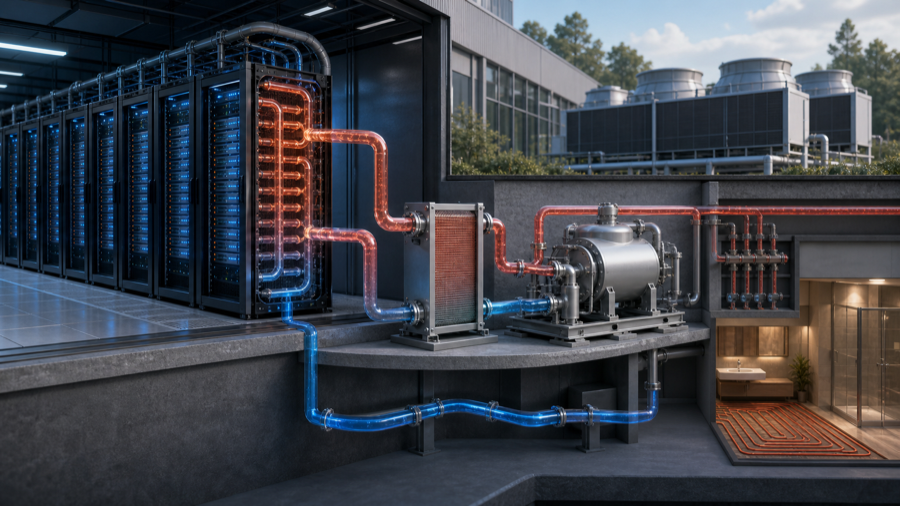
As data center energy demand approaches grid-level constraints, optimizing conventional server infrastructure is essential for sustainable growth. The long-standing assumption that "cooler is better", i.e., lower CPU temperatures reduce power, does not fully hold for modern low-voltage CPUs, where inverse temperature dependence (ITD) drives higher supply voltages at lower temperatures. This creates a non-monotonic performance-per-watt curve where efficiency peaks at an intermediate thermal point. In this paper, for the first time, we empirically characterize ITD on production Intel Xeon CPUs and demonstrate that efficiency-optimal temperatures are CPU part-specific, and frequently higher than typical data center operating conditions. Measurements from commercial cloud data center platforms (Amazon, Equinix) reveal that approximately half of modern high-power CPUs operate about 10°C below their efficiency-optimal thermal point. By implementing ITD-aware thermal grouping of CPUs and inlet temperature adjustments, data center operators can optimize facility-level cooling and overall sustainability. Our case study shows that this approach can reduce total data center energy by 4-13% without sacrificing performance or reliability.

arXivPreprint
Read the paper & insight

Cooling & thermal management/ Related research

Space-CIM: Enabling Compute-In-Memory Accelerators for Thermally-Constrained Space Platforms

The rapid growth in compute demand from artificial intelligence (AI) has driven a massive surge in data center construction, precipitating an energy and sustainability crisis. Motivated by the abundant solar energy in outer space and the recent sharp reduction in space launch costs, orbital data centers are emerging as a potential pathway for the future scaling of AI compute infrastructure. While the cold background in vacuum seems appealing for cooling, computing systems operating in space without convection ultimately rely on radiative cooling, requiring large-area radiators. Such limitations in thermal management pose a significant challenge for deploying the standard liquid/air-cooled computers in space. In this work, we investigate the impact of the thermal constraints in space on both graphics processing units (GPUs) with high-bandwidth memory (HBM) and the emerging compute-in-memory (CIM) accelerators. We develop a radiator-in-the-loop co-design methodology that directly links the permitted system TOPS (terra-operations per second) with the practical radiator cooling capacity in space. Our thermal simulations reveal that the separately located GPU die and HBMs create severe thermal hotspots under limited radiator capacity, necessitating GPU thermal throttling. In contrast, CIM accelerators exhibit a much more uniform heat distribution and consistently outperform GPUs in TOPS/W across a wide range of radiator budgets. We systematically evaluated the performance of CIM and GPU across various AI workloads and demonstrated that CIM has a magnified advantage for deployment in space under realistic thermal constraints.

arXivPreprint

Resources & environment/ Related research

Recasting AI Data Centers as Engines for Carbon Removal

AI data centers (AIDCs) are rapidly increasing electricity demand and associated CO2 emissions, yet they also generate continuous low-grade waste heat. Here, we assess whether this heat can be upgraded by heat pumps to drive direct air capture (DAC) and reduce the climate impact of AI infrastructure. We develop a thermodynamically integrated DAC-AIDC system and conduct a region-resolved assessment across the United States, accounting for AIDC capacity, server composition, local climate, electricity prices, and grid carbon intensity. We find that AIDC waste heat can substantially improve net CO2 removal and lower the levelized cost of capture. In carbon-intensive regions, integration can flip DAC from net-positive to net-negative. Under a 2030 scenario with more GPU-intensive AIDCs and cleaner grids, several states achieve removal ratios above 1, indicating that integrated systems can offset their own operational emissions and deliver additional carbon removal.

arXivPreprint

READING NOTEStart with the research insight, then examine the methods, comparisons and conditions.

RESEARCH & PERSPECTIVES

Papers & insights

Leave each paper with a question worth pursuing.

8 papers

Cooling & thermal management

01

Revisiting "Cooler is Better": ITD-Aware Per-CPU Thermal Optimization for Sustainable Data Center Operation

arXivPreprint
Research overview

As data center energy demand approaches grid-level constraints, optimizing conventional server infrastructure is essential for sustainable growth. The long-standing assumption that "cooler is better", i.e., lower CPU temperatures reduce power, does not fully hold for modern low-voltage CPUs, where inverse temperature dependence (ITD) drives higher supply voltages at lower temperatures. This creates a non-monotonic performance-per-watt curve where efficiency peaks at an intermediate thermal point. In this paper, for the first time, we empirically characterize ITD on production Intel Xeon CPUs and demonstrate that efficiency-optimal temperatures are CPU part-specific, and frequently higher than typical data center operating conditions. Measurements from commercial cloud data center platforms (Amazon, Equinix) reveal that approximately half of modern high-power CPUs operate about 10°C below their efficiency-optimal thermal point. By implementing ITD-aware thermal grouping of CPUs and inlet temperature adjustments, data center operators can optimize facility-level cooling and overall sustainability. Our case study shows that this approach can reduce total data center energy by 4-13% without sacrificing performance or reliability.

Abstract & detailed commentary

Jason Crop, Hayden Moore, Sudeep Pasricha

Chinese abstract

As data center energy demand approaches grid-level constraints, optimizing conventional server infrastructure is essential for sustainable growth. The long-standing assumption that "cooler is better", i.e., lower CPU temperatures reduce power, does not fully hold for modern low-voltage CPUs, where inverse temperature dependence (ITD) drives higher supply voltages at lower temperatures. This creates a non-monotonic performance-per-watt curve where efficiency peaks at an intermediate thermal point. In this paper, for the first time, we empirically characterize ITD on production Intel Xeon CPUs and demonstrate that efficiency-optimal temperatures are CPU part-specific, and frequently higher than typical data center operating conditions. Measurements from commercial cloud data center platforms (Amazon, Equinix) reveal that approximately half of modern high-power CPUs operate about 10°C below their efficiency-optimal thermal point. By implementing ITD-aware thermal grouping of CPUs and inlet temperature adjustments, data center operators can optimize facility-level cooling and overall sustainability. Our case study shows that this approach can reduce total data center energy by 4-13% without sacrificing performance or reliability.

Original paperChinese poster

Cooling & thermal management

02

Space-CIM: Enabling Compute-In-Memory Accelerators for Thermally-Constrained Space Platforms

arXivPreprint
Research overview

The rapid growth in compute demand from artificial intelligence (AI) has driven a massive surge in data center construction, precipitating an energy and sustainability crisis. Motivated by the abundant solar energy in outer space and the recent sharp reduction in space launch costs, orbital data centers are emerging as a potential pathway for the future scaling of AI compute infrastructure. While the cold background in vacuum seems appealing for cooling, computing systems operating in space without convection ultimately rely on radiative cooling, requiring large-area radiators. Such limitations in thermal management pose a significant challenge for deploying the standard liquid/air-cooled computers in space. In this work, we investigate the impact of the thermal constraints in space on both graphics processing units (GPUs) with high-bandwidth memory (HBM) and the emerging compute-in-memory (CIM) accelerators. We develop a radiator-in-the-loop co-design methodology that directly links the permitted system TOPS (terra-operations per second) with the practical radiator cooling capacity in space. Our thermal simulations reveal that the separately located GPU die and HBMs create severe thermal hotspots under limited radiator capacity, necessitating GPU thermal throttling. In contrast, CIM accelerators exhibit a much more uniform heat distribution and consistently outperform GPUs in TOPS/W across a wide range of radiator budgets. We systematically evaluated the performance of CIM and GPU across various AI workloads and demonstrated that CIM has a magnified advantage for deployment in space under realistic thermal constraints.

Abstract & detailed commentary

Sohan Salahuddin Mugdho, Md. Shahedul Hasan, Cheng Wang

Chinese abstract

The rapid growth in compute demand from artificial intelligence (AI) has driven a massive surge in data center construction, precipitating an energy and sustainability crisis. Motivated by the abundant solar energy in outer space and the recent sharp reduction in space launch costs, orbital data centers are emerging as a potential pathway for the future scaling of AI compute infrastructure. While the cold background in vacuum seems appealing for cooling, computing systems operating in space without convection ultimately rely on radiative cooling, requiring large-area radiators. Such limitations in thermal management pose a significant challenge for deploying the standard liquid/air-cooled computers in space. In this work, we investigate the impact of the thermal constraints in space on both graphics processing units (GPUs) with high-bandwidth memory (HBM) and the emerging compute-in-memory (CIM) accelerators. We develop a radiator-in-the-loop co-design methodology that directly links the permitted system TOPS (terra-operations per second) with the practical radiator cooling capacity in space. Our thermal simulations reveal that the separately located GPU die and HBMs create severe thermal hotspots under limited radiator capacity, necessitating GPU thermal throttling. In contrast, CIM accelerators exhibit a much more uniform heat distribution and consistently outperform GPUs in TOPS/W across a wide range of radiator budgets. We systematically evaluated the performance of CIM and GPU across various AI workloads and demonstrated that CIM has a magnified advantage for deployment in space under realistic thermal constraints.

Original paperChinese poster

Resources & environment

03

Recasting AI Data Centers as Engines for Carbon Removal

arXivPreprint
Research overview

AI data centers (AIDCs) are rapidly increasing electricity demand and associated CO2 emissions, yet they also generate continuous low-grade waste heat. Here, we assess whether this heat can be upgraded by heat pumps to drive direct air capture (DAC) and reduce the climate impact of AI infrastructure. We develop a thermodynamically integrated DAC-AIDC system and conduct a region-resolved assessment across the United States, accounting for AIDC capacity, server composition, local climate, electricity prices, and grid carbon intensity. We find that AIDC waste heat can substantially improve net CO2 removal and lower the levelized cost of capture. In carbon-intensive regions, integration can flip DAC from net-positive to net-negative. Under a 2030 scenario with more GPU-intensive AIDCs and cleaner grids, several states achieve removal ratios above 1, indicating that integrated systems can offset their own operational emissions and deliver additional carbon removal.

Abstract & detailed commentary

No reliable data

Chinese abstract

AI data centers (AIDCs) are rapidly increasing electricity demand and associated CO2 emissions, yet they also generate continuous low-grade waste heat. Here, we assess whether this heat can be upgraded by heat pumps to drive direct air capture (DAC) and reduce the climate impact of AI infrastructure. We develop a thermodynamically integrated DAC-AIDC system and conduct a region-resolved assessment across the United States, accounting for AIDC capacity, server composition, local climate, electricity prices, and grid carbon intensity. We find that AIDC waste heat can substantially improve net CO2 removal and lower the levelized cost of capture. In carbon-intensive regions, integration can flip DAC from net-positive to net-negative. Under a 2030 scenario with more GPU-intensive AIDCs and cleaner grids, several states achieve removal ratios above 1, indicating that integrated systems can offset their own operational emissions and deliver additional carbon removal.

Original paperChinese poster

Compute–power coordination

04

Power Grid Infrastructure for AI Data Centers

arXivPreprint
Research overview

This article addresses recent advances in artificial intelligence, which have set off an astounding race among technology frontiers to build large data centers. It provides insights into impacts of large data centers on the planning and operation of the power grid.

Abstract & detailed commentary

Amir Sajadi, Muhy Eddin Za'ter, Maria Vabson, Kyri Baker, Bri-Mathias Hodge

Chinese abstract

This article addresses recent advances in artificial intelligence, which have set off an astounding race among technology frontiers to build large data centers. It provides insights into impacts of large data centers on the planning and operation of the power grid.

Original paperChinese poster

AI & modeling

05

Provisioning to Runtime Optimization of a 100 MW-Scale AI Cluster

arXivPreprint
Research overview

The electric power supply for AI data centers is now the most significant bottleneck in the race toward Artificial General Intelligence, surpassing even the constraint of AI accelerator availability. To our knowledge, this paper is the first to describe the end-to-end power management process for a hyper-scale AI datacenter; from early power planning to accommodate next-generation accelerators 6--12 months before their general availability, to tuning power settings after large scale deployment, and finally to dynamic, runtime power management for evolving workloads. We present detailed power measurements for a 150 MW datacenter hosting a cluster of 83K GB200 GPUs. We share insights from building this state-of-the-art AI cluster. We hope this work encourages practitioners across the industry to share their own experiences as well.

Abstract & detailed commentary

Ehsan K. Ardestani, Leonardo Piga, Jovan Stojkovic, Pavan Balaji, Mustafa Ozdal, Mikel Jimenez Fernandez, Mihaela Dimovska, Luka Tadic

Chinese abstract

The electric power supply for AI data centers is now the most significant bottleneck in the race toward Artificial General Intelligence, surpassing even the constraint of AI accelerator availability. To our knowledge, this paper is the first to describe the end-to-end power management process for a hyper-scale AI datacenter; from early power planning to accommodate next-generation accelerators 6--12 months before their general availability, to tuning power settings after large scale deployment, and finally to dynamic, runtime power management for evolving workloads. We present detailed power measurements for a 150 MW datacenter hosting a cluster of 83K GB200 GPUs. We share insights from building this state-of-the-art AI cluster. We hope this work encourages practitioners across the industry to share their own experiences as well.

Original paperChinese poster

Compute–power coordination

06

GridPilot: Real-Time Grid-Responsive Control for AI Supercomputers

arXivPreprint
Research overview

At global scale, data-center electricity demand is growing faster than the grids that supply it, while system operators increasingly require large flexible loads that can adjust power within seconds to absorb variable wind and solar generation. For multi-megawatt AI/HPC facilities, the key unresolved question is practical and measurable: how quickly can the software stack translate a grid request into a real change in GPU power at the facility meter, where commitments are settled? We answer this on real hardware with GridPilot, a three-tier predictive controller operating across milliseconds, seconds, and hours, augmented by a deterministic safety-island bypass for fast response. On a three-GPU NVIDIA V100 testbed, GridPilot achieves a measured end-to-end trigger-to-target response of 97.2 ms, which is 6.9x faster than the 700 ms requirement of Nordic Fast Frequency Reserve. We further incorporate an instantaneous Power Usage Effectiveness (PUE) correction so dispatched commitments remain robust at meter level rather than only at IT load level. In replay experiments across six representative European grids (from Sweden to Poland), the PUE-aware controller closes 2.5-5.8 percentage points of cooling-overhead drag. GridPilot is released as open source and serves as a proof of concept that MW-scale AI/HPC demand can be engineered as controllable, grid-responsive flexibility by design.

Abstract & detailed commentary

Denisa-Andreea Constantinescu, David Atienza

Chinese abstract

At global scale, data-center electricity demand is growing faster than the grids that supply it, while system operators increasingly require large flexible loads that can adjust power within seconds to absorb variable wind and solar generation. For multi-megawatt AI/HPC facilities, the key unresolved question is practical and measurable: how quickly can the software stack translate a grid request into a real change in GPU power at the facility meter, where commitments are settled? We answer this on real hardware with GridPilot, a three-tier predictive controller operating across milliseconds, seconds, and hours, augmented by a deterministic safety-island bypass for fast response. On a three-GPU NVIDIA V100 testbed, GridPilot achieves a measured end-to-end trigger-to-target response of 97.2 ms, which is 6.9x faster than the 700 ms requirement of Nordic Fast Frequency Reserve. We further incorporate an instantaneous Power Usage Effectiveness (PUE) correction so dispatched commitments remain robust at meter level rather than only at IT load level. In replay experiments across six representative European grids (from Sweden to Poland), the PUE-aware controller closes 2.5-5.8 percentage points of cooling-overhead drag. GridPilot is released as open source and serves as a proof of concept that MW-scale AI/HPC demand can be engineered as controllable, grid-responsive flexibility by design.

Original paperChinese poster

Computing & systems

07

ScaleAcross Explorer: Exploring Communication Optimization for Scale-Across AI Model Training

arXivPreprint
Research overview

The rapid scaling of large language model training requires distributing GPU resources across multiple data center buildings and regions. We refer to such paradigm as "scale-across" training. As infrastructure expands, the system design space becomes increasingly intricate, encompassing new model architectures, hardware heterogeneity, and evolving communication patterns. Drawing from Meta's production experience, we highlight the complexities of deploying training jobs across a few data centers housing hundreds of thousands of GPUs. To accelerate exploration of the large design space and to enable efficient training for frontier model development, we conduct in-depth characterization of three key design dimensions: parallelism placement, parallelism scheduling, and network layer technologies. We then propose ScaleAcross Explorer, an optimizer that considers the interplay of design dimensions and holistically optimizes scale-across training. Testbed experiments and simulations demonstrate up to 64.62% training speedups over production configuration and up to 37.59% training speedups over the state-of-the-art baseline across a wide range of design points.

Abstract & detailed commentary

Minghao Li, Alicia Golden, Samuel Hsia, Michael Kuchnik, Adi Gangidi, Xu Zhang, Ashmitha Jeevaraj Shetty, Zachary DeVito

Chinese abstract

The rapid scaling of large language model training requires distributing GPU resources across multiple data center buildings and regions. We refer to such paradigm as "scale-across" training. As infrastructure expands, the system design space becomes increasingly intricate, encompassing new model architectures, hardware heterogeneity, and evolving communication patterns. Drawing from Meta's production experience, we highlight the complexities of deploying training jobs across a few data centers housing hundreds of thousands of GPUs. To accelerate exploration of the large design space and to enable efficient training for frontier model development, we conduct in-depth characterization of three key design dimensions: parallelism placement, parallelism scheduling, and network layer technologies. We then propose ScaleAcross Explorer, an optimizer that considers the interplay of design dimensions and holistically optimizes scale-across training. Testbed experiments and simulations demonstrate up to 64.62% training speedups over production configuration and up to 37.59% training speedups over the state-of-the-art baseline across a wide range of design points.

Original paperChinese poster

Computing & systems

08

Towards Resource-Efficient LLMs: End-to-End Energy Accounting of Distillation Pipelines

Semantic Scholar
Research overview

The rise in deployment of large language models has driven a surge in GPU demand and datacenter scaling, raising concerns about electricity use, grid stress, and the impacts of modern AI workloads. Distillation is often promoted as one of the most effective paths to obtain cheaper, more efficient models, yet these claims rarely account for the full end-to-end energy and resource costs, including crucial teacher-side workloads such as data generation, logit caching, and evaluation. We present a comprehensive energy accounting framework that measures the complete computational cost of distillation pipelines via detailed stage-wise tracking of GPU device power consumption. In our experiments, we separate and log empirical energy use across distinct phases and systematically measure the energy and emissions of two common distillation methods: the classic logit-based knowledge distillation and synthetic-data supervised fine-tuning, constructing energy-quality Pareto frontiers that expose the previously ignored costs. From these measurements and analyses, we derive practical design rules for selecting distillation methods and hyperparameters under energy and budget constraints, and release an open-source measurement harness and accounting protocol to provide a standardized foundation for comparable, reproducible distillation research, explicitly accountable for complete pipeline energy impact.

Abstract & detailed commentary

Katherine Lambert, Sasha Luccioni

Chinese abstract

The rise in deployment of large language models has driven a surge in GPU demand and datacenter scaling, raising concerns about electricity use, grid stress, and the impacts of modern AI workloads. Distillation is often promoted as one of the most effective paths to obtain cheaper, more efficient models, yet these claims rarely account for the full end-to-end energy and resource costs, including crucial teacher-side workloads such as data generation, logit caching, and evaluation. We present a comprehensive energy accounting framework that measures the complete computational cost of distillation pipelines via detailed stage-wise tracking of GPU device power consumption. In our experiments, we separate and log empirical energy use across distinct phases and systematically measure the energy and emissions of two common distillation methods: the classic logit-based knowledge distillation and synthetic-data supervised fine-tuning, constructing energy-quality Pareto frontiers that expose the previously ignored costs. From these measurements and analyses, we derive practical design rules for selecting distillation methods and hyperparameters under energy and budget constraints, and release an open-source measurement harness and accounting protocol to provide a standardized foundation for comparable, reproducible distillation research, explicitly accountable for complete pipeline energy impact.

Original paperChinese poster