Research Article算电协同
Yugui Liu、Yibo Ding、Xudong Li、Jing Qu、Wenyi Zhang、Tong Qian、Wuyou Xiao、Zhengyang Hu
Published 2026-06-03 · arXiv · Credibility S
Energy-intensive data centers (DCs) have emerged as substantial and flexible loads in modern power systems, underscoring the critical need for computation-electricity coordination. Harnessing the spatio-temporal flexibility of DC workloads is a promising approach to facilitate this coordination. However, existing studies overlook the collaborative potential of computational resource sharing among geo-distributed DCs…
Abstract, interpretation and reference
Abstract
Energy-intensive data centers (DCs) have emerged as substantial and flexible loads in modern power systems, underscoring the critical need for computation-electricity coordination. Harnessing the spatio-temporal flexibility of DC workloads is a promising approach to facilitate this coordination. However, existing studies overlook the collaborative potential of computational resource sharing among geo-distributed DCs, thereby failing to fully unlock this flexibility. In this paper, a bi-level computation-electricity coordination framework is proposed to explicitly capture the bidirectional interactions between DCs and power grid. Firstly, a peer-to-peer cloud service market (P2P-CSM) for geo-distributed DCs is proposed, which enables bilateral cloud service transactions to leverage regional heterogeneities (e.g., electricity prices, cooling efficiency). Secondly, locational marginal prices are embedded into the framework to reflect network congestion and nodal price disparities. Thirdly, a dual consensus alternating direction method of multipliers (ADMM)-based decentralized algorithm is developed as the P2P market clearing algorithm, and a bisection-assisted iterative algorithm is proposed to ensure rigorous convergence of the framework. Case studies conducted on modified IEEE 30-bus system validate that the P2P-CSM achieves a win-win computation-electricity coordination: it not only increases total DC operational profit by 22.8\%, but also effectively alleviates grid congestion and yields a 3.2\% reduction in total energy consumption.
中文解读
背景:AI 数据中心负载、功率密度和能源约束同步上升,算力负载与电网侧资源的协同调度正在成为智算中心设计的关键变量。问题:论文聚焦现有方案在效率、可靠性或工程协同上的瓶颈。方法:摘要显示作者采用框架构建和频域/系统级分析,把运行负载、冷却/能源系统和基础设施约束放在同一分析框架中。结果:研究重点指向AI 负载波动对电网设备寿命和调频边界的影响。意义:对日报读者而言,它可用于判断智算中心建设是否受电网容量、负载波动和调度机制约束。仍需结合全文实验条件、样本范围和成本假设核验。
参考文献
Yugui Liu, Yibo Ding, Xudong Li, 等. Peer-to-Peer Cloud Service Market for Data Centers Oriented to Computation-Electricity Coordination[J/OL]. (2026-06-03)[2026-06-30]. http://arxiv.org/abs/2606.04981v1.

Research Article热管理与液冷
Shaolei Ren、Mohammad A. Islam、Adam Wierman
Published 2026-05-30 · arXiv · Credibility S
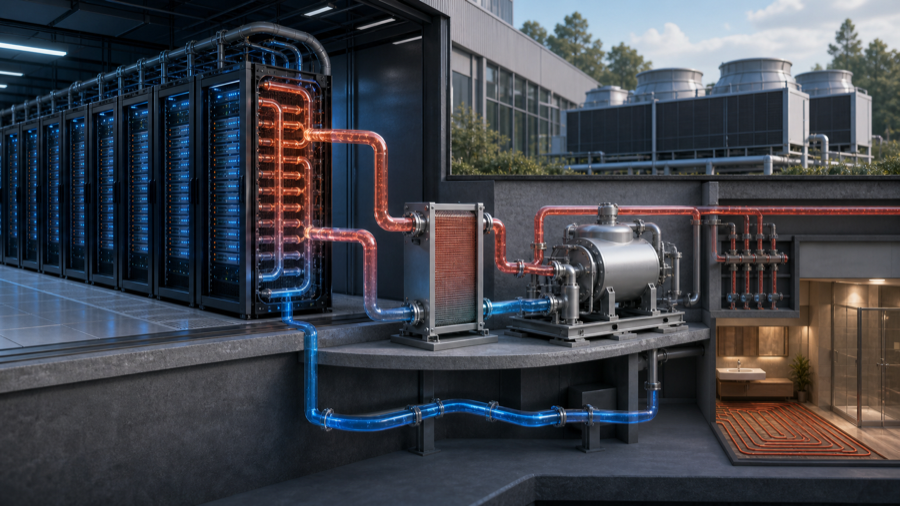
The deployment of artificial intelligence is increasingly constrained by limited site-level power capacity, which must support both compute systems and non-compute systems (primarily cooling) at all times. Cooling power demand, especially in non-evaporative cooling systems, can increase substantially with ambient temperature in the summer, producing recurring periods of elevated cooling power that often lasts for mu…
Abstract, interpretation and reference
Abstract
The deployment of artificial intelligence is increasingly constrained by limited site-level power capacity, which must support both compute systems and non-compute systems (primarily cooling) at all times. Cooling power demand, especially in non-evaporative cooling systems, can increase substantially with ambient temperature in the summer, producing recurring periods of elevated cooling power that often lasts for multiple hours per day. Therefore, maximizing compute capacity under a limited site-level power budget is an important planning and operational challenge. Sizing the compute system conservatively based on peak cooling power can leave part of the site-level power capacity underutilized when the cooling power is below its peak, particularly in cooler months. On the other hand, sizing the compute system aggressively based on low cooling power can cause the total site-level power demand to exceed the site-level power capacity during hot days in the summer. This paper proposes ComputeAmp (Compute Amplifier), a framework that maximizes the compute capacity by jointly and dynamically leveraging cooling, battery energy storage, and computing-based adaptation. We discuss the opportunities and limitations of ComputeAmp and illustrate its potential to significantly expand usable compute capacity within local power and water resource limits. We also present a problem formulation for ComputeAmp and highlight a few algorithmic and operational challenges.
中文解读
背景:AI 数据中心负载、功率密度和能源约束同步上升,液冷、热管理和数据中心能效正在成为智算中心设计的关键变量。问题:论文聚焦现有方案在效率、可靠性或工程协同上的瓶颈。方法:摘要显示作者采用框架构建和频域/系统级分析,把运行负载、冷却/能源系统和基础设施约束放在同一分析框架中。结果:研究重点指向冷却效率、能源利用或运维策略的改进方向。意义:对日报读者而言,它可用于判断液冷方案、热管理路线和高密度部署节奏。仍需结合全文实验条件、样本范围和成本假设核验。
参考文献
Shaolei Ren, Mohammad A. Islam, Adam Wierman. Maximizing Compute Capacity in AI Data Centers through Cooling, Energy Storage, and Computing Adaptation[J/OL]. (2026-05-30)[2026-06-30]. http://arxiv.org/abs/2606.00457v1.
Research ArticleAI 运维优化
Shuyi Chen、Zhengchang Hua、Nikos Tziritas、Georgios Theodoropoulos
Published 2026-06-23 · arXiv · Credibility S
Terrestrial AI training faces an unsustainable energy and water crisis, positioning Orbital Data Centers (ODCs) as a "zero operational carbon" alternative. However, the sub-$10μ\text{s}$ communication latency required for distributed Large Language Model (LLM) training forces ODCs into extreme physical density, triggering a critical "Proximity-Thermal Paradox." As these high-density systems scale into Monolithic Str…
Abstract, interpretation and reference
Abstract
Terrestrial AI training faces an unsustainable energy and water crisis, positioning Orbital Data Centers (ODCs) as a "zero operational carbon" alternative. However, the sub-$10μ\text{s}$ communication latency required for distributed Large Language Model (LLM) training forces ODCs into extreme physical density, triggering a critical "Proximity-Thermal Paradox." As these high-density systems scale into Monolithic Structures or Proximity Swarms, they suffer from intense thermal-fluid crosstalk (heat traps in shared cooling loops) and thermal-radiative crosstalk (mutual heating that blocks deep-space cooling radiators). If left unmitigated, this persistent heat stagnation not only triggers severe thermal throttling that degrades training throughput, but also induces severe thermal fatigue, drastically shortening hardware lifespans and generating premature space e-waste. To make orbital AI truly sustainable, this position paper challenges traditional uniform load-sharing. We propose the Thermal-Aware Heterogeneity Thesis, which treats spatial cooling variances as a primary resource management dimension. Building on this, we introduce Thermal-Load Balancing (TLB), a software framework that dynamically migrates LLM workloads to the coolest available units based on instantaneous fluid temperatures or absorbed radiation. Our analysis demonstrates that TLB resolves thermal bottlenecks to restore Model Flops Utilization (MFU), while simultaneously reducing physical thermal stress. Extending the operational lifespan of orbital hardware is crucial to amortize the massive embodied carbon of rocket launches, outlining a necessary pathway to scale orbital AI without accelerating e-waste.
中文解读
背景:AI 数据中心负载、功率密度和能源约束同步上升,AI 运维、负载预测和设施调优正在成为智算中心设计的关键变量。问题:论文聚焦现有方案在效率、可靠性或工程协同上的瓶颈。方法:摘要显示作者采用建模优化、调度分析或算法评估,把运行负载、冷却/能源系统和基础设施约束放在同一分析框架中。结果:研究重点指向AI 负载波动对电网设备寿命和调频边界的影响。意义:对日报读者而言,它可用于判断AI 工具是否能降低运维复杂度并提升可用性。仍需结合全文实验条件、样本范围和成本假设核验。
参考文献
Shuyi Chen, Zhengchang Hua, Nikos Tziritas, 等. Hot AI in Cold Space: Thermal-Crosstalk-Aware Scheduling for Sustainable Orbital AI Clusters[J/OL]. (2026-06-23)[2026-06-30]. http://arxiv.org/abs/2606.26150v1.
Research Article算电协同
Jason Crop、Hayden Moore、Sudeep Pasricha
Published 2026-06-10 · arXiv · Credibility S
As data center energy demand approaches grid-level constraints, optimizing conventional server infrastructure is essential for sustainable growth. The long-standing assumption that "cooler is better", i.e., lower CPU temperatures reduce power, does not fully hold for modern low-voltage CPUs, where inverse temperature dependence (ITD) drives higher supply voltages at lower temperatures. This creates a non-monotonic p…
Abstract, interpretation and reference
Abstract
As data center energy demand approaches grid-level constraints, optimizing conventional server infrastructure is essential for sustainable growth. The long-standing assumption that "cooler is better", i.e., lower CPU temperatures reduce power, does not fully hold for modern low-voltage CPUs, where inverse temperature dependence (ITD) drives higher supply voltages at lower temperatures. This creates a non-monotonic performance-per-watt curve where efficiency peaks at an intermediate thermal point. In this paper, for the first time, we empirically characterize ITD on production Intel Xeon CPUs and demonstrate that efficiency-optimal temperatures are CPU part-specific, and frequently higher than typical data center operating conditions. Measurements from commercial cloud data center platforms (Amazon, Equinix) reveal that approximately half of modern high-power CPUs operate about 10°C below their efficiency-optimal thermal point. By implementing ITD-aware thermal grouping of CPUs and inlet temperature adjustments, data center operators can optimize facility-level cooling and overall sustainability. Our case study shows that this approach can reduce total data center energy by 4-13% without sacrificing performance or reliability.
中文解读
背景:AI 数据中心负载、功率密度和能源约束同步上升,算力负载与电网侧资源的协同调度正在成为智算中心设计的关键变量。问题:论文聚焦现有方案在效率、可靠性或工程协同上的瓶颈。方法:摘要显示作者采用建模优化、调度分析或算法评估,把运行负载、冷却/能源系统和基础设施约束放在同一分析框架中。结果:研究重点指向AI 负载波动对电网设备寿命和调频边界的影响。意义:对日报读者而言,它可用于判断智算中心建设是否受电网容量、负载波动和调度机制约束。仍需结合全文实验条件、样本范围和成本假设核验。
参考文献
Jason Crop, Hayden Moore, Sudeep Pasricha. Revisiting "Cooler is Better": ITD-Aware Per-CPU Thermal Optimization for Sustainable Data Center Operation[J/OL]. (2026-06-10)[2026-06-30]. http://arxiv.org/abs/2606.11163v1.
Research Article热管理与液冷
Kai-Hsin Hung、Sumaya Nur Adan、Krupa Suchak、Armita Sadeghian Barzoki、Kofi Yeboah、Mohammad Amir Anwar
Published 2026-06-24 · arXiv · Credibility S
Artificial intelligence depends on large-scale compute resources and their supporting infrastructure. However, AI governance debates treat compute primarily as a technical input rather than as an outcome of investment, ownership, and financial control. This paper examines AI infrastructure investment flows across Africa through a systematic analysis of 46 publicly announced projects totalling USD $12.7 billion betwe…
Abstract, interpretation and reference
Abstract
Artificial intelligence depends on large-scale compute resources and their supporting infrastructure. However, AI governance debates treat compute primarily as a technical input rather than as an outcome of investment, ownership, and financial control. This paper examines AI infrastructure investment flows across Africa through a systematic analysis of 46 publicly announced projects totalling USD $12.7 billion between 2019 and 2025. Using a value chain framework, we analyze who invests in AI-relevant infrastructure and where investments concentrate. Our findings reveal a highly concentrated landscape dominated by global data center operators, hyperscale technology firms, and development finance institutions, clustering in South Africa, Kenya, Nigeria, and Egypt. We introduce asymmetrical interdependence to describe a structural condition in which capital and physical infrastructure account for 73% of total funding while control remains concentrated in the compute layer among a small number of global technology firms. We argue that compute governance must account for capital flows, ownership, and control, not only geographic access, because these dynamics shape AI compute equity. Infrastructure presence is necessary but insufficient for meaningful governance capacity.
中文解读
背景:AI 数据中心负载、功率密度和能源约束同步上升,液冷、热管理和数据中心能效正在成为智算中心设计的关键变量。问题:论文聚焦现有方案在效率、可靠性或工程协同上的瓶颈。方法:摘要显示作者采用综述归纳和指标比较,把运行负载、冷却/能源系统和基础设施约束放在同一分析框架中。结果:研究重点指向能效评价口径、运营指标和优化目标的系统化梳理。意义:对日报读者而言,它可用于判断液冷方案、热管理路线和高密度部署节奏。仍需结合全文实验条件、样本范围和成本假设核验。
参考文献
Kai-Hsin Hung, Sumaya Nur Adan, Krupa Suchak, 等. Financing Artificial Intelligence Infrastructure: Mapping AI Infrastructure Investment and Compute Governance Across Africa[J/OL]. (2026-06-24)[2026-06-30]. http://arxiv.org/abs/2606.28404v1.
Research Article算电协同
Chris Williams、Philip Colangelo、Ayse Coskun、Ethan Levine、Andy Neale、Ciaran Roberts、Shayan Sengupta、Nikhil Shirolkar
Published 2026-06-24 · arXiv · Credibility S
The rapid expansion of artificial intelligence (AI) infrastructure is driving unprecedented growth in electricity demand from data centers. Traditional power-system planning treats large computing facilities as inflexible peak loads, leading to costly infrastructure upgrades and long delays in grid interconnection. Recent work has shown that AI clusters can reduce electricity consumption during peak demand through s…
Abstract, interpretation and reference
Abstract
The rapid expansion of artificial intelligence (AI) infrastructure is driving unprecedented growth in electricity demand from data centers. Traditional power-system planning treats large computing facilities as inflexible peak loads, leading to costly infrastructure upgrades and long delays in grid interconnection. Recent work has shown that AI clusters can reduce electricity consumption during peak demand through software-based workload orchestration. This article explores how modern GPU-based AI data centers can operate as grid-interactive assets that respond dynamically to power system conditions. We describe an architecture integrating grid signals, workload scheduling, and power telemetry for fine-grained cluster power control. Experimental results from a real-world deployment on a 130 kW GPU cluster demonstrate multiple forms of flexibility, including rapid load reduction, sustained curtailment, and carbon-aware operation while preserving service levels for priority jobs. We further demonstrate performance-aware load shifting across geographically distributed clusters, enabling workloads to migrate toward regions with lower grid stress. Together, these capabilities transform AI infrastructure from static electricity consumers into flexible resources that support grid reliability, accelerate interconnection, and improve computing sustainability.
中文解读
背景:AI 数据中心负载、功率密度和能源约束同步上升,算力负载与电网侧资源的协同调度正在成为智算中心设计的关键变量。问题:论文聚焦现有方案在效率、可靠性或工程协同上的瓶颈。方法:摘要显示作者采用建模优化、调度分析或算法评估,把运行负载、冷却/能源系统和基础设施约束放在同一分析框架中。结果:研究重点指向AI 负载波动对电网设备寿命和调频边界的影响。意义:对日报读者而言,它可用于判断智算中心建设是否受电网容量、负载波动和调度机制约束。仍需结合全文实验条件、样本范围和成本假设核验。
参考文献
Chris Williams, Philip Colangelo, Ayse Coskun, 等. Power-Flexible AI Data Centers: A New Paradigm for Grid-Responsive Compute[J/OL]. (2026-06-24)[2026-06-30]. http://arxiv.org/abs/2606.25098v1.
Research Article热管理与液冷
Basit A. Akinade、Amobichukwu C. Amanambu、Jonathan M. Frame、Shaolei Ren
Published 2026-06-20 · arXiv · Credibility S
AI data centres consume water for cooling, water scarcity constrains siting, and AI tools can improve water system efficiency. These dynamics are studied separately yet form a feedback loop. This review formalises the Water and AI Feedback Loop, introduces the Water Consumption Impact index to quantify community-scale utility burden, and demonstrates across ten US sites that burden spans three orders of magnitude, f…
Abstract, interpretation and reference
Abstract
AI data centres consume water for cooling, water scarcity constrains siting, and AI tools can improve water system efficiency. These dynamics are studied separately yet form a feedback loop. This review formalises the Water and AI Feedback Loop, introduces the Water Consumption Impact index to quantify community-scale utility burden, and demonstrates across ten US sites that burden spans three orders of magnitude, from 0.2% to 134% of host capacity.
中文解读
背景:AI 数据中心负载、功率密度和能源约束同步上升,液冷、热管理和数据中心能效正在成为智算中心设计的关键变量。问题:论文聚焦现有方案在效率、可靠性或工程协同上的瓶颈。方法:摘要显示作者采用综述归纳和指标比较,把运行负载、冷却/能源系统和基础设施约束放在同一分析框架中。结果:研究重点指向冷却效率、能源利用或运维策略的改进方向。意义:对日报读者而言,它可用于判断液冷方案、热管理路线和高密度部署节奏。仍需结合全文实验条件、样本范围和成本假设核验。
参考文献
Basit A. Akinade, Amobichukwu C. Amanambu, Jonathan M. Frame, 等. AI Data Centers and the Water Use Feedback Loop[J/OL]. (2026-06-20)[2026-06-30]. http://arxiv.org/abs/2606.21760v1.
Research Article热管理与液冷
Sangwhee Lee、Rafal P. Wojda、Cheol-Hee Jo、Shuntaro Inoue、Pedro Ribeiro、Gui-Jia Su、Mostak Mohammad、Himel Barua
Published 2026-06-24 · arXiv · Credibility S
The rapid growth of AI workloads is driving unprecedented increases in data center power demand, current transients, and thermal stress, exposing fundamental limitations in traditional 48 V rack architectures, low-voltage AC distribution, and line-frequency transformer interfaces. This paper reviews the three stages of architectural shifts required to support next-generation AI data centers and identifies three enab…
Abstract, interpretation and reference
Abstract
The rapid growth of AI workloads is driving unprecedented increases in data center power demand, current transients, and thermal stress, exposing fundamental limitations in traditional 48 V rack architectures, low-voltage AC distribution, and line-frequency transformer interfaces. This paper reviews the three stages of architectural shifts required to support next-generation AI data centers and identifies three enabling technological building blocks: high-voltage conversion-ratio DC/DC converters, facility-level low-voltage DC distribution, and medium-voltage solid-state transformers. The advantages, technical challenges, and potential solutions associated with each building block are reviewed. Finally, future research directions and open challenges are discussed.
中文解读
背景:AI 数据中心负载、功率密度和能源约束同步上升,液冷、热管理和数据中心能效正在成为智算中心设计的关键变量。问题:论文聚焦现有方案在效率、可靠性或工程协同上的瓶颈。方法:摘要显示作者采用综述归纳和指标比较,把运行负载、冷却/能源系统和基础设施约束放在同一分析框架中。结果:研究重点指向跨地域数据中心负载与电力资源之间的调度关系。意义:对日报读者而言,它可用于判断液冷方案、热管理路线和高密度部署节奏。仍需结合全文实验条件、样本范围和成本假设核验。
参考文献
Sangwhee Lee, Rafal P. Wojda, Cheol-Hee Jo, 等. Toward Next-Generation AI Data Centers: Power Delivery Architecture Shifts, Emerging Technologies, and Challenges[J/OL]. (2026-06-24)[2026-06-30]. http://arxiv.org/abs/2606.25095v1.