Research ArticleAI 运维优化
Zihan Yu、Xianling Zeng、Zhiming Xue、Yalun Qi、Sichen Zhao
Published 2026-06-19 · arXiv · Credibility S
The rapid growth of large-scale AI workloads, particularly Large Language Model (LLM) training and inference, is fundamentally reshaping the operational dynamics of hyperscale data centers. Unlike traditional cloud workloads, AI-driven jobs exhibit bursty, high-intensity, and rapidly shifting resource demands, often leading to sudden capacity stress that cannot be effectively handled by reactive threshold-based mech…
Abstract, interpretation and reference
Abstract
The rapid growth of large-scale AI workloads, particularly Large Language Model (LLM) training and inference, is fundamentally reshaping the operational dynamics of hyperscale data centers. Unlike traditional cloud workloads, AI-driven jobs exhibit bursty, high-intensity, and rapidly shifting resource demands, often leading to sudden capacity stress that cannot be effectively handled by reactive threshold-based mechanisms. In this paper, we propose a deployment-oriented, burst-aware early warning framework for proactive capacity stress prediction under AI workload surges. We formulate the problem as a high-recall forecasting task over multivariate telemetry windows, with the explicit goal of enabling operational intervention before system degradation occurs. The proposed framework integrates workload intensity, temporal variation, and system pressure signals, and employs a lightweight tree-based learning model to capture nonlinear interactions in highly imbalanced environments. To evaluate the system under realistic conditions, we introduce an AI workload surge injection methodology that simulates burst-driven demand patterns observed in large-scale AI systems. Our XGBoost-based model achieves an ROC AUC of 0.697 and an AP of 0.670, significantly outperforming baseline methods. Under deployment-oriented threshold selection, the framework achieves a Recall of 0.914, enabling the detection of the majority of stress-prone periods with acceptable false-alarm cost. Beyond predictive performance, we show how the proposed framework can be integrated into operational control loops to support proactive actions such as workload throttling and resource scaling. Our results highlight the practical value of high-recall, learning-based early warning systems in enabling resilient and adaptive data center operations in the era of AI-driven workloads.
中文解读
背景:AI 数据中心负载、功率密度和能源约束同步上升,AI 运维、负载预测和设施调优正在成为智算中心设计的关键变量。问题:论文聚焦现有方案在效率、可靠性或工程协同上的瓶颈。方法:摘要显示作者采用框架构建和频域/系统级分析,把运行负载、冷却/能源系统和基础设施约束放在同一分析框架中。结果:研究重点指向跨地域数据中心负载与电力资源之间的调度关系。意义:对日报读者而言,它可用于判断AI 工具是否能降低运维复杂度并提升可用性。仍需结合全文实验条件、样本范围和成本假设核验。
参考文献
Zihan Yu, Xianling Zeng, Zhiming Xue, 等. Learning Burst-Aware Early Warning Models for Capacity Stress under AI Workload Surges in Hyperscale Data Centers[J/OL]. (2026-06-19)[2026-07-03]. http://arxiv.org/abs/2606.21130v1.
Research Article算电协同
Chandan Chaudhary、Michael Murillo、Mohammed Ben-Idris、Joydeep Mitra、Dilip Pandit、Atri Bera
Published 2026-06-12 · arXiv · Credibility S
Hyperscale AI data centers induce spatially and temporally correlated load fluctuations that violate classical independence assumptions and are not captured by time-averaged spectral methods. These correlations are episodic and non-stationary, so they demand analysis that resolves transient structure. This paper applies Dynamic Mode Decomposition (DMD) to the temporal evolution of pairwise inter-bus correlation coef…
Abstract, interpretation and reference
Abstract
Hyperscale AI data centers induce spatially and temporally correlated load fluctuations that violate classical independence assumptions and are not captured by time-averaged spectral methods. These correlations are episodic and non-stationary, so they demand analysis that resolves transient structure. This paper applies Dynamic Mode Decomposition (DMD) to the temporal evolution of pairwise inter-bus correlation coefficients and forms a low-dimensional state representation that enables modal analysis without a stationarity assumption. The recovered modes distinguish sustained coherence, decaying transients, and intensifying events, and their oscillation timescales map to underlying physical coupling mechanisms. The method is evaluated on an IEEE 39-bus Real-Time Digital Simulator (RTDS) testbed with three converter-interfaced AI data center loads driven by synthetic workload profiles. A global analysis attributes the dominant correlation energy to a slow thermal band, and a sliding-window analysis identifies brief intensification events in a small fraction of windows that align with stochastic workload coincidences. Cross-validation with RTDS voltage coherence confirms elevated coupling during these intervals. The proposed modal growth indicator provides an early-warning signal of correlation intensification, with a lead of of about 4~s before pairwise coherence reaches its peak.
中文解读
背景:AI 数据中心负载、功率密度和能源约束同步上升,算力负载与电网侧资源的协同调度正在成为智算中心设计的关键变量。问题:论文聚焦现有方案在效率、可靠性或工程协同上的瓶颈。方法:摘要显示作者采用仿真建模和情景分析,把运行负载、冷却/能源系统和基础设施约束放在同一分析框架中。结果:研究重点指向跨地域数据中心负载与电力资源之间的调度关系。意义:对日报读者而言,它可用于判断智算中心建设是否受电网容量、负载波动和调度机制约束。仍需结合全文实验条件、样本范围和成本假设核验。
参考文献
Chandan Chaudhary, Michael Murillo, Mohammed Ben-Idris, 等. Modal Analysis of Spatial Load Correlation in AI Data Center-Dominated Power Systems[J/OL]. (2026-06-12)[2026-07-03]. http://arxiv.org/abs/2606.13847v2.
Research Article余热回收
Shrenik Jadhav、Vidhyashree Nagaraju、Zheng Liu
Published 2026-06-14 · arXiv · Credibility S
Liquid cooled supercomputers dissipate tens of megawatts of waste heat through cooling plants organized as parallel subloops that serve coolant distribution units. The number of subloops and the assignment of units to them are design decisions fixed at construction, yet they have not been systematically optimized for facilities at this scale. As electricity grids decarbonize, embodied carbon becomes a larger share o…
Abstract, interpretation and reference
Abstract
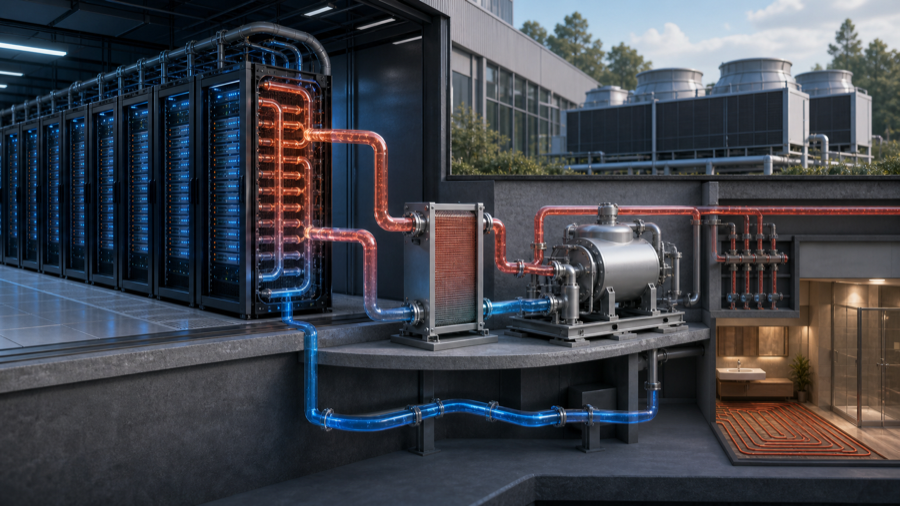
Liquid cooled supercomputers dissipate tens of megawatts of waste heat through cooling plants organized as parallel subloops that serve coolant distribution units. The number of subloops and the assignment of units to them are design decisions fixed at construction, yet they have not been systematically optimized for facilities at this scale. As electricity grids decarbonize, embodied carbon becomes a larger share of facility life cycle emissions and the cost of an unnecessary subloop becomes harder to justify. We present a framework that integrates operational energy from a validated control optimizer based on sequential least squares programming, embodied carbon from a bill of materials, and expected unplanned downtime from a per subloop reliability model. The framework is applied to the Frontier supercomputer, evaluating all 611 ways of partitioning its 25 coolant distribution units into two through six subloops. The life cycle cost and carbon optimum is found at two subloops holding 14 and 11 units, achieving 3,320.7 tonnes of carbon dioxide equivalent and $3.99 million over a seven year horizon, a saving of 50.2 tonnes and $100,000 compared to built four subloop configuration. The optimum remains on the Pareto front in all 15 scenarios of a one at a time sensitivity sweep. A semi-analytical decision rule generalizes the result, predicting four subloops for Aurora, two for El Capitan, and one for LUMI. When reliability is treated as a hard constraint set by operations policy, the four subloop Frontier deployment is consistent with the constrained optimum.
中文解读
背景:AI 数据中心负载、功率密度和能源约束同步上升,余热回收、热泵耦合和二次能源利用正在成为智算中心设计的关键变量。问题:论文聚焦现有方案在效率、可靠性或工程协同上的瓶颈。方法:摘要显示作者采用综述归纳和指标比较,把运行负载、冷却/能源系统和基础设施约束放在同一分析框架中。结果:研究重点指向AI 负载波动对电网设备寿命和调频边界的影响。意义:对日报读者而言,它可用于判断数据中心余热能否从成本项转化为能源资产。仍需结合全文实验条件、样本范围和成本假设核验。
参考文献
Shrenik Jadhav, Vidhyashree Nagaraju, Zheng Liu. Data Center Life Cycle Co-Design Optimization[J/OL]. (2026-06-14)[2026-07-03]. http://arxiv.org/abs/2606.15408v1.
Research Article芯片与算力
Sohan Salahuddin Mugdho、Md. Shahedul Hasan、Cheng Wang
Published 2026-06-04 · arXiv · Credibility S
The rapid growth in compute demand from artificial intelligence (AI) has driven a massive surge in data center construction, precipitating an energy and sustainability crisis. Motivated by the abundant solar energy in outer space and the recent sharp reduction in space launch costs, orbital data centers are emerging as a potential pathway for the future scaling of AI compute infrastructure. While the cold background…
Abstract, interpretation and reference
Abstract
The rapid growth in compute demand from artificial intelligence (AI) has driven a massive surge in data center construction, precipitating an energy and sustainability crisis. Motivated by the abundant solar energy in outer space and the recent sharp reduction in space launch costs, orbital data centers are emerging as a potential pathway for the future scaling of AI compute infrastructure. While the cold background in vacuum seems appealing for cooling, computing systems operating in space without convection ultimately rely on radiative cooling, requiring large-area radiators. Such limitations in thermal management pose a significant challenge for deploying the standard liquid/air-cooled computers in space. In this work, we investigate the impact of the thermal constraints in space on both graphics processing units (GPUs) with high-bandwidth memory (HBM) and the emerging compute-in-memory (CIM) accelerators. We develop a radiator-in-the-loop co-design methodology that directly links the permitted system TOPS (terra-operations per second) with the practical radiator cooling capacity in space. Our thermal simulations reveal that the separately located GPU die and HBMs create severe thermal hotspots under limited radiator capacity, necessitating GPU thermal throttling. In contrast, CIM accelerators exhibit a much more uniform heat distribution and consistently outperform GPUs in TOPS/W across a wide range of radiator budgets. We systematically evaluated the performance of CIM and GPU across various AI workloads and demonstrated that CIM has a magnified advantage for deployment in space under realistic thermal constraints.
中文解读
背景:AI 数据中心负载、功率密度和能源约束同步上升,芯片、服务器和高密度算力部署正在成为智算中心设计的关键变量。问题:论文聚焦现有方案在效率、可靠性或工程协同上的瓶颈。方法:摘要显示作者采用综述归纳和指标比较,把运行负载、冷却/能源系统和基础设施约束放在同一分析框架中。结果:研究重点指向跨地域数据中心负载与电力资源之间的调度关系。意义:对日报读者而言,它可用于判断芯片路线和服务器密度变化如何传导到机房设计。仍需结合全文实验条件、样本范围和成本假设核验。
参考文献
Sohan Salahuddin Mugdho, Md. Shahedul Hasan, Cheng Wang. Space-CIM: Enabling Compute-In-Memory Accelerators for Thermally-Constrained Space Platforms[J/OL]. (2026-06-04)[2026-07-03]. http://arxiv.org/abs/2606.05741v1.

Research Article算电协同
Yijie Yang、Xi Weng、Yue Chen
Published 2026-06-16 · arXiv · Credibility S
The rapid growth of AI workloads is substantially increasing data center electricity demand and carbon emissions, motivating the development of carbon-aware scheduling methods. However, effective scheduling is challenging because renewable generation and AI workloads are subject to forecast errors, while training and inference workloads exhibit heterogeneity in computational characteristics. This paper proposes a co…
Abstract, interpretation and reference
Abstract
The rapid growth of AI workloads is substantially increasing data center electricity demand and carbon emissions, motivating the development of carbon-aware scheduling methods. However, effective scheduling is challenging because renewable generation and AI workloads are subject to forecast errors, while training and inference workloads exhibit heterogeneity in computational characteristics. This paper proposes a contextual robust optimization framework for AI data center operation. The proposed model explicitly captures the heterogeneous computational characteristics of AI training and inference workloads. To deal with renewable generation and workload forecast errors, we develop loss-based uncertainty learning models that directly map contextual features to covariate-dependent uncertainty sets. The resulting contextual joint chance-constrained scheduling problem is reformulated into a tractable robust optimization problem, and a calibration algorithm is developed to provide finite-sample probabilistic feasibility guarantees for multiple joint chance constraints. Numerical experiments based on real-world AI workload traces and renewable generation data show that the proposed method reduces operating costs by an average of 5.57% compared to benchmark methods while maintaining reliable feasibility and strong computational scalability.
中文解读
背景:AI 数据中心负载、功率密度和能源约束同步上升,算力负载与电网侧资源的协同调度正在成为智算中心设计的关键变量。问题:论文聚焦现有方案在效率、可靠性或工程协同上的瓶颈。方法:摘要显示作者采用建模优化、调度分析或算法评估,把运行负载、冷却/能源系统和基础设施约束放在同一分析框架中。结果:研究重点指向跨地域数据中心负载与电力资源之间的调度关系。意义:对日报读者而言,它可用于判断智算中心建设是否受电网容量、负载波动和调度机制约束。仍需结合全文实验条件、样本范围和成本假设核验。
参考文献
Yijie Yang, Xi Weng, Yue Chen. Contextual Robust Optimization for AI Data Center Scheduling with Statistical Guarantees[J/OL]. (2026-06-16)[2026-07-03]. http://arxiv.org/abs/2606.17466v1.
Research Article算电协同
Yugui Liu、Yibo Ding、Xudong Li、Jing Qu、Wenyi Zhang、Tong Qian、Wuyou Xiao、Zhengyang Hu
Published 2026-06-03 · arXiv · Credibility S
Energy-intensive data centers (DCs) have emerged as substantial and flexible loads in modern power systems, underscoring the critical need for computation-electricity coordination. Harnessing the spatio-temporal flexibility of DC workloads is a promising approach to facilitate this coordination. However, existing studies overlook the collaborative potential of computational resource sharing among geo-distributed DCs…
Abstract, interpretation and reference
Abstract
Energy-intensive data centers (DCs) have emerged as substantial and flexible loads in modern power systems, underscoring the critical need for computation-electricity coordination. Harnessing the spatio-temporal flexibility of DC workloads is a promising approach to facilitate this coordination. However, existing studies overlook the collaborative potential of computational resource sharing among geo-distributed DCs, thereby failing to fully unlock this flexibility. In this paper, a bi-level computation-electricity coordination framework is proposed to explicitly capture the bidirectional interactions between DCs and power grid. Firstly, a peer-to-peer cloud service market (P2P-CSM) for geo-distributed DCs is proposed, which enables bilateral cloud service transactions to leverage regional heterogeneities (e.g., electricity prices, cooling efficiency). Secondly, locational marginal prices are embedded into the framework to reflect network congestion and nodal price disparities. Thirdly, a dual consensus alternating direction method of multipliers (ADMM)-based decentralized algorithm is developed as the P2P market clearing algorithm, and a bisection-assisted iterative algorithm is proposed to ensure rigorous convergence of the framework. Case studies conducted on modified IEEE 30-bus system validate that the P2P-CSM achieves a win-win computation-electricity coordination: it not only increases total DC operational profit by 22.8\%, but also effectively alleviates grid congestion and yields a 3.2\% reduction in total energy consumption.
中文解读
背景:AI 数据中心负载、功率密度和能源约束同步上升,算力负载与电网侧资源的协同调度正在成为智算中心设计的关键变量。问题:论文聚焦现有方案在效率、可靠性或工程协同上的瓶颈。方法:摘要显示作者采用框架构建和频域/系统级分析,把运行负载、冷却/能源系统和基础设施约束放在同一分析框架中。结果:研究重点指向AI 负载波动对电网设备寿命和调频边界的影响。意义:对日报读者而言,它可用于判断智算中心建设是否受电网容量、负载波动和调度机制约束。仍需结合全文实验条件、样本范围和成本假设核验。
参考文献
Yugui Liu, Yibo Ding, Xudong Li, 等. Peer-to-Peer Cloud Service Market for Data Centers Oriented to Computation-Electricity Coordination[J/OL]. (2026-06-03)[2026-07-03]. http://arxiv.org/abs/2606.04981v1.
Research Article算电协同
Jason Crop、Hayden Moore、Sudeep Pasricha
Published 2026-06-10 · arXiv · Credibility S
As data center energy demand approaches grid-level constraints, optimizing conventional server infrastructure is essential for sustainable growth. The long-standing assumption that "cooler is better", i.e., lower CPU temperatures reduce power, does not fully hold for modern low-voltage CPUs, where inverse temperature dependence (ITD) drives higher supply voltages at lower temperatures. This creates a non-monotonic p…
Abstract, interpretation and reference
Abstract
As data center energy demand approaches grid-level constraints, optimizing conventional server infrastructure is essential for sustainable growth. The long-standing assumption that "cooler is better", i.e., lower CPU temperatures reduce power, does not fully hold for modern low-voltage CPUs, where inverse temperature dependence (ITD) drives higher supply voltages at lower temperatures. This creates a non-monotonic performance-per-watt curve where efficiency peaks at an intermediate thermal point. In this paper, for the first time, we empirically characterize ITD on production Intel Xeon CPUs and demonstrate that efficiency-optimal temperatures are CPU part-specific, and frequently higher than typical data center operating conditions. Measurements from commercial cloud data center platforms (Amazon, Equinix) reveal that approximately half of modern high-power CPUs operate about 10°C below their efficiency-optimal thermal point. By implementing ITD-aware thermal grouping of CPUs and inlet temperature adjustments, data center operators can optimize facility-level cooling and overall sustainability. Our case study shows that this approach can reduce total data center energy by 4-13% without sacrificing performance or reliability.
中文解读
背景:AI 数据中心负载、功率密度和能源约束同步上升,算力负载与电网侧资源的协同调度正在成为智算中心设计的关键变量。问题:论文聚焦现有方案在效率、可靠性或工程协同上的瓶颈。方法:摘要显示作者采用建模优化、调度分析或算法评估,把运行负载、冷却/能源系统和基础设施约束放在同一分析框架中。结果:研究重点指向AI 负载波动对电网设备寿命和调频边界的影响。意义:对日报读者而言,它可用于判断智算中心建设是否受电网容量、负载波动和调度机制约束。仍需结合全文实验条件、样本范围和成本假设核验。
参考文献
Jason Crop, Hayden Moore, Sudeep Pasricha. Revisiting "Cooler is Better": ITD-Aware Per-CPU Thermal Optimization for Sustainable Data Center Operation[J/OL]. (2026-06-10)[2026-07-03]. http://arxiv.org/abs/2606.11163v1.
Research Article算电协同
Jiachen Shen、Jian Shi、Yijie Yang、Chenye Wu、Dan Wang、Ju Bin Song、Zhu Han
Published 2026-07-01 · arXiv · Credibility S
Thermal management in AI data centers is increasingly challenged by bursty workloads and uncertain heat generation. To prevent thermal violations, existing cooling strategies either enforce conservative, rigid bounds that severely limit grid responsiveness, or rely on forecast-driven controllers that perform poorly under AI workload uncertainty and distribution shifts. To overcome the above challenges, this paper pr…
Abstract, interpretation and reference
Abstract
Thermal management in AI data centers is increasingly challenged by bursty workloads and uncertain heat generation. To prevent thermal violations, existing cooling strategies either enforce conservative, rigid bounds that severely limit grid responsiveness, or rely on forecast-driven controllers that perform poorly under AI workload uncertainty and distribution shifts. To overcome the above challenges, this paper proposes a Contextual Distributionally Robust Optimization (CDRO) framework for grid-interactive cooling control. Unlike standard DRO with fixed ambiguity sets, the proposed approach dynamically adapts the Wasserstein radius using real-time AI and grid context. This safely shrinks uncertainty bounds during stable regimes, unlocking deep demand-side flexibility. Theoretically, we formulate the control as an infinite-dimensional inf-sup problem, derive an exact tractable reformulation for the Wasserstein worst-case expected-cost term, and then derive a tractable conservative deterministic counterpart for the Distributionally Robust Conditional Value at Risk (DR-CVaR) thermal safety constraint. Solved via a scalable nested Alternating Direction Method of Multipliers (ADMM) algorithm, the CDRO controller achieves near-zero thermal violations under extreme workload spikes in high-fidelity EnergyPlus co-simulations. Simultaneously, it reduces the operational cost premium of robustness by approximately 13.7 percentage points relative to standard Min-Max Model Predictive Control (MPC).
中文解读
背景:AI 数据中心负载、功率密度和能源约束同步上升,算力负载与电网侧资源的协同调度正在成为智算中心设计的关键变量。问题:论文聚焦现有方案在效率、可靠性或工程协同上的瓶颈。方法:摘要显示作者采用建模优化、调度分析或算法评估,把运行负载、冷却/能源系统和基础设施约束放在同一分析框架中。结果:研究重点指向AI 负载波动对电网设备寿命和调频边界的影响。意义:对日报读者而言,它可用于判断智算中心建设是否受电网容量、负载波动和调度机制约束。仍需结合全文实验条件、样本范围和成本假设核验。
参考文献
Jiachen Shen, Jian Shi, Yijie Yang, 等. Grid-Interactive Thermal Management of AI Data Centers via Contextual Distributionally Robust Optimization[J/OL]. (2026-07-01)[2026-07-03]. http://arxiv.org/abs/2607.00099v1.