Research Article热管理与液冷
Sangwhee Lee、Rafal P. Wojda、Cheol-Hee Jo、Shuntaro Inoue、Pedro Ribeiro、Gui-Jia Su、Mostak Mohammad、Himel Barua
Published 2026-06-24 · arXiv · Credibility S
The rapid growth of AI workloads is driving unprecedented increases in data center power demand, current transients, and thermal stress, exposing fundamental limitations in traditional 48 V rack architectures, low-voltage AC distribution, and line-frequency transformer interfaces. This paper reviews the three stages of architectural shifts required to support next-generation AI data centers and identifies three enab…
Abstract, interpretation and reference
Abstract
The rapid growth of AI workloads is driving unprecedented increases in data center power demand, current transients, and thermal stress, exposing fundamental limitations in traditional 48 V rack architectures, low-voltage AC distribution, and line-frequency transformer interfaces. This paper reviews the three stages of architectural shifts required to support next-generation AI data centers and identifies three enabling technological building blocks: high-voltage conversion-ratio DC/DC converters, facility-level low-voltage DC distribution, and medium-voltage solid-state transformers. The advantages, technical challenges, and potential solutions associated with each building block are reviewed. Finally, future research directions and open challenges are discussed.
中文解读
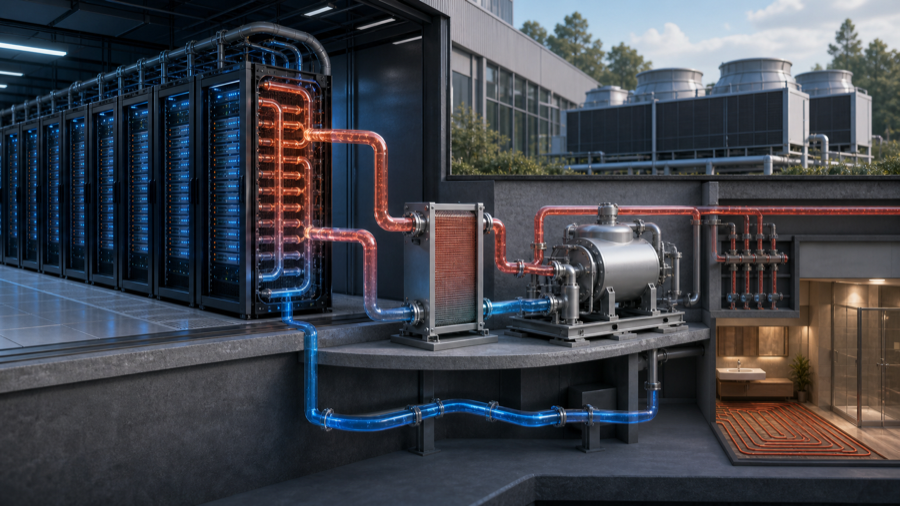
背景:AI 数据中心负载、功率密度和能源约束同步上升,液冷、热管理和数据中心能效正在成为智算中心设计的关键变量。问题:论文聚焦现有方案在效率、可靠性或工程协同上的瓶颈。方法:摘要显示作者采用综述归纳和指标比较,把运行负载、冷却/能源系统和基础设施约束放在同一分析框架中。结果:研究重点指向跨地域数据中心负载与电力资源之间的调度关系。意义:对日报读者而言,它可用于判断液冷方案、热管理路线和高密度部署节奏。仍需结合全文实验条件、样本范围和成本假设核验。
参考文献
Sangwhee Lee, Rafal P. Wojda, Cheol-Hee Jo, 等. Toward Next-Generation AI Data Centers: Power Delivery Architecture Shifts, Emerging Technologies, and Challenges[J/OL]. (2026-06-24)[2026-07-11]. http://arxiv.org/abs/2606.25095v1.
Research Article算电协同
Soham Ghosh、Anik Goswami、Krishna Kumba
Published 2026-06-11 · arXiv · Credibility S
Floating solar photovoltaic (FSPV) systems provide a land-efficient pathway to expand clean electricity access in energy-poor regions. South America has among the highest global FSPV potential (approx 38.26 TWh per million acres of water surface), yet deployment remains limited. This study presents a techno-socio-economic framework to assess FSPV for energy access, water security, and grid flexibility, with case stu…
Abstract, interpretation and reference
Abstract
Floating solar photovoltaic (FSPV) systems provide a land-efficient pathway to expand clean electricity access in energy-poor regions. South America has among the highest global FSPV potential (approx 38.26 TWh per million acres of water surface), yet deployment remains limited. This study presents a techno-socio-economic framework to assess FSPV for energy access, water security, and grid flexibility, with case studies in Nicaragua, Honduras, and Guyana. Estimated yields for 50 to 398 MW systems exceed 1,500 to 2,000 kWh per kW annually with capacity factors above 20 percent. At El Cajon, FSPV could significantly reduce emissions relative to fossil generation. Results show competitive costs with land-based PV when accounting for avoided land use, shared hydropower infrastructure, and water benefits. The framework also highlights co-location with hydropower and AI data centers, offering a scalable model for deployment in underserved regions.
中文解读
背景:AI 数据中心负载、功率密度和能源约束同步上升,算力负载与电网侧资源的协同调度正在成为智算中心设计的关键变量。问题:论文聚焦现有方案在效率、可靠性或工程协同上的瓶颈。方法:摘要显示作者采用框架构建和频域/系统级分析,把运行负载、冷却/能源系统和基础设施约束放在同一分析框架中。结果:研究重点指向AI 负载波动对电网设备寿命和调频边界的影响。意义:对日报读者而言,它可用于判断智算中心建设是否受电网容量、负载波动和调度机制约束。仍需结合全文实验条件、样本范围和成本假设核验。
参考文献
Soham Ghosh, Anik Goswami, Krishna Kumba. Pushing the Frontiers for Floating Solar Photovoltaics -- The Case for South America[J/OL]. (2026-06-11)[2026-07-11]. http://arxiv.org/abs/2606.12798v1.

Research Article余热回收
Shrenik Jadhav、Vidhyashree Nagaraju、Zheng Liu
Published 2026-06-14 · arXiv · Credibility S
Liquid cooled supercomputers dissipate tens of megawatts of waste heat through cooling plants organized as parallel subloops that serve coolant distribution units. The number of subloops and the assignment of units to them are design decisions fixed at construction, yet they have not been systematically optimized for facilities at this scale. As electricity grids decarbonize, embodied carbon becomes a larger share o…
Abstract, interpretation and reference
Abstract
Liquid cooled supercomputers dissipate tens of megawatts of waste heat through cooling plants organized as parallel subloops that serve coolant distribution units. The number of subloops and the assignment of units to them are design decisions fixed at construction, yet they have not been systematically optimized for facilities at this scale. As electricity grids decarbonize, embodied carbon becomes a larger share of facility life cycle emissions and the cost of an unnecessary subloop becomes harder to justify. We present a framework that integrates operational energy from a validated control optimizer based on sequential least squares programming, embodied carbon from a bill of materials, and expected unplanned downtime from a per subloop reliability model. The framework is applied to the Frontier supercomputer, evaluating all 611 ways of partitioning its 25 coolant distribution units into two through six subloops. The life cycle cost and carbon optimum is found at two subloops holding 14 and 11 units, achieving 3,320.7 tonnes of carbon dioxide equivalent and $3.99 million over a seven year horizon, a saving of 50.2 tonnes and $100,000 compared to built four subloop configuration. The optimum remains on the Pareto front in all 15 scenarios of a one at a time sensitivity sweep. A semi-analytical decision rule generalizes the result, predicting four subloops for Aurora, two for El Capitan, and one for LUMI. When reliability is treated as a hard constraint set by operations policy, the four subloop Frontier deployment is consistent with the constrained optimum.
中文解读
背景:AI 数据中心负载、功率密度和能源约束同步上升,余热回收、热泵耦合和二次能源利用正在成为智算中心设计的关键变量。问题:论文聚焦现有方案在效率、可靠性或工程协同上的瓶颈。方法:摘要显示作者采用综述归纳和指标比较,把运行负载、冷却/能源系统和基础设施约束放在同一分析框架中。结果:研究重点指向AI 负载波动对电网设备寿命和调频边界的影响。意义:对日报读者而言,它可用于判断数据中心余热能否从成本项转化为能源资产。仍需结合全文实验条件、样本范围和成本假设核验。
参考文献
Shrenik Jadhav, Vidhyashree Nagaraju, Zheng Liu. Data Center Life Cycle Co-Design Optimization[J/OL]. (2026-06-14)[2026-07-11]. http://arxiv.org/abs/2606.15408v1.
Research ArticleAI 运维优化
Zihan Yu、Xianling Zeng、Zhiming Xue、Yalun Qi、Sichen Zhao
Published 2026-06-19 · arXiv · Credibility S
The rapid growth of large-scale AI workloads, particularly Large Language Model (LLM) training and inference, is fundamentally reshaping the operational dynamics of hyperscale data centers. Unlike traditional cloud workloads, AI-driven jobs exhibit bursty, high-intensity, and rapidly shifting resource demands, often leading to sudden capacity stress that cannot be effectively handled by reactive threshold-based mech…
Abstract, interpretation and reference
Abstract
The rapid growth of large-scale AI workloads, particularly Large Language Model (LLM) training and inference, is fundamentally reshaping the operational dynamics of hyperscale data centers. Unlike traditional cloud workloads, AI-driven jobs exhibit bursty, high-intensity, and rapidly shifting resource demands, often leading to sudden capacity stress that cannot be effectively handled by reactive threshold-based mechanisms. In this paper, we propose a deployment-oriented, burst-aware early warning framework for proactive capacity stress prediction under AI workload surges. We formulate the problem as a high-recall forecasting task over multivariate telemetry windows, with the explicit goal of enabling operational intervention before system degradation occurs. The proposed framework integrates workload intensity, temporal variation, and system pressure signals, and employs a lightweight tree-based learning model to capture nonlinear interactions in highly imbalanced environments. To evaluate the system under realistic conditions, we introduce an AI workload surge injection methodology that simulates burst-driven demand patterns observed in large-scale AI systems. Our XGBoost-based model achieves an ROC AUC of 0.697 and an AP of 0.670, significantly outperforming baseline methods. Under deployment-oriented threshold selection, the framework achieves a Recall of 0.914, enabling the detection of the majority of stress-prone periods with acceptable false-alarm cost. Beyond predictive performance, we show how the proposed framework can be integrated into operational control loops to support proactive actions such as workload throttling and resource scaling. Our results highlight the practical value of high-recall, learning-based early warning systems in enabling resilient and adaptive data center operations in the era of AI-driven workloads.
中文解读
背景:AI 数据中心负载、功率密度和能源约束同步上升,AI 运维、负载预测和设施调优正在成为智算中心设计的关键变量。问题:论文聚焦现有方案在效率、可靠性或工程协同上的瓶颈。方法:摘要显示作者采用框架构建和频域/系统级分析,把运行负载、冷却/能源系统和基础设施约束放在同一分析框架中。结果:研究重点指向跨地域数据中心负载与电力资源之间的调度关系。意义:对日报读者而言,它可用于判断AI 工具是否能降低运维复杂度并提升可用性。仍需结合全文实验条件、样本范围和成本假设核验。
参考文献
Zihan Yu, Xianling Zeng, Zhiming Xue, 等. Learning Burst-Aware Early Warning Models for Capacity Stress under AI Workload Surges in Hyperscale Data Centers[J/OL]. (2026-06-19)[2026-07-11]. http://arxiv.org/abs/2606.21130v1.

Research Article热管理与液冷
Liton Kumar Biswas、Katayoon Yahyaei、Shajib Ghosh、M Shafkat M Khan、Himanandhan Reddy Kottur、Rayhane Ghane-Motlagh、Mahdi Nikdast、Navid Asadizanjani
Published 2026-06-25 · arXiv · Credibility S
Photonic Integrated Circuits (PICs) are advancing high-performance computing, data centers, and sensing, yet three-dimensional (3D) PICs introduce critical thermal management challenges due to high-density bonding and heterogeneous materials. Traditional methods like thermal microscopes and in-package sensors yield sparse data, limiting full thermal profile visibility. This paper presents a dual-method solution comb…
Abstract, interpretation and reference
Abstract
Photonic Integrated Circuits (PICs) are advancing high-performance computing, data centers, and sensing, yet three-dimensional (3D) PICs introduce critical thermal management challenges due to high-density bonding and heterogeneous materials. Traditional methods like thermal microscopes and in-package sensors yield sparse data, limiting full thermal profile visibility. This paper presents a dual-method solution combining an AI-driven thermal modeling framework with a design-based heuristic approach. The AI method integrates sparse sensor data with design layer and density information to predict multilayer temperature variations, while the heuristic approach uses localized material properties, design layout, component geometries, and sensor coordinates to refine thermal estimations in specific regions. A 2D thermal map of a 3D PIC is generated by interpolating sensor data and adjusting for local thermal resistivity using comparative analysis between design regions. The heuristic method complements the AI model, improving estimation accuracy without extensive training data. Together, these methods offer a scalable, accurate solution for real-time thermal mapping and design-time simulation, enabling reliable thermal management in next-generation 3D photonic systems.
中文解读
背景:AI 数据中心负载、功率密度和能源约束同步上升,液冷、热管理和数据中心能效正在成为智算中心设计的关键变量。问题:论文聚焦现有方案在效率、可靠性或工程协同上的瓶颈。方法:摘要显示作者采用框架构建和频域/系统级分析,把运行负载、冷却/能源系统和基础设施约束放在同一分析框架中。结果:研究重点指向冷却效率、能源利用或运维策略的改进方向。意义:对日报读者而言,它可用于判断液冷方案、热管理路线和高密度部署节奏。仍需结合全文实验条件、样本范围和成本假设核验。
参考文献
Liton Kumar Biswas, Katayoon Yahyaei, Shajib Ghosh, 等. AI-Driven Thermal Mapping and Management in 3D Integrated Photonic Circuits[J/OL]. (2026-06-25)[2026-07-11]. http://arxiv.org/abs/2607.07711v1.

Research Article算电协同
Yijie Yang、Xi Weng、Yue Chen
Published 2026-06-16 · arXiv · Credibility S
The rapid growth of AI workloads is substantially increasing data center electricity demand and carbon emissions, motivating the development of carbon-aware scheduling methods. However, effective scheduling is challenging because renewable generation and AI workloads are subject to forecast errors, while training and inference workloads exhibit heterogeneity in computational characteristics. This paper proposes a co…
Abstract, interpretation and reference
Abstract
The rapid growth of AI workloads is substantially increasing data center electricity demand and carbon emissions, motivating the development of carbon-aware scheduling methods. However, effective scheduling is challenging because renewable generation and AI workloads are subject to forecast errors, while training and inference workloads exhibit heterogeneity in computational characteristics. This paper proposes a contextual robust optimization framework for AI data center operation. The proposed model explicitly captures the heterogeneous computational characteristics of AI training and inference workloads. To deal with renewable generation and workload forecast errors, we develop loss-based uncertainty learning models that directly map contextual features to covariate-dependent uncertainty sets. The resulting contextual joint chance-constrained scheduling problem is reformulated into a tractable robust optimization problem, and a calibration algorithm is developed to provide finite-sample probabilistic feasibility guarantees for multiple joint chance constraints. Numerical experiments based on real-world AI workload traces and renewable generation data show that the proposed method reduces operating costs by an average of 5.57% compared to benchmark methods while maintaining reliable feasibility and strong computational scalability.
中文解读
背景:AI 数据中心负载、功率密度和能源约束同步上升,算力负载与电网侧资源的协同调度正在成为智算中心设计的关键变量。问题:论文聚焦现有方案在效率、可靠性或工程协同上的瓶颈。方法:摘要显示作者采用建模优化、调度分析或算法评估,把运行负载、冷却/能源系统和基础设施约束放在同一分析框架中。结果:研究重点指向跨地域数据中心负载与电力资源之间的调度关系。意义:对日报读者而言,它可用于判断智算中心建设是否受电网容量、负载波动和调度机制约束。仍需结合全文实验条件、样本范围和成本假设核验。
参考文献
Yijie Yang, Xi Weng, Yue Chen. Contextual Robust Optimization for AI Data Center Scheduling with Statistical Guarantees[J/OL]. (2026-06-16)[2026-07-11]. http://arxiv.org/abs/2606.17466v1.
Research Article算电协同
Chandan Chaudhary、Michael Murillo、Mohammed Ben-Idris、Joydeep Mitra、Dilip Pandit、Atri Bera
Published 2026-06-12 · arXiv · Credibility S
Hyperscale AI data centers induce spatially and temporally correlated load fluctuations that violate classical independence assumptions and are not captured by time-averaged spectral methods. These correlations are episodic and non-stationary, so they demand analysis that resolves transient structure. This paper applies Dynamic Mode Decomposition (DMD) to the temporal evolution of pairwise inter-bus correlation coef…
Abstract, interpretation and reference
Abstract
Hyperscale AI data centers induce spatially and temporally correlated load fluctuations that violate classical independence assumptions and are not captured by time-averaged spectral methods. These correlations are episodic and non-stationary, so they demand analysis that resolves transient structure. This paper applies Dynamic Mode Decomposition (DMD) to the temporal evolution of pairwise inter-bus correlation coefficients and forms a low-dimensional state representation that enables modal analysis without a stationarity assumption. The recovered modes distinguish sustained coherence, decaying transients, and intensifying events, and their oscillation timescales map to underlying physical coupling mechanisms. The method is evaluated on an IEEE 39-bus Real-Time Digital Simulator (RTDS) testbed with three converter-interfaced AI data center loads driven by synthetic workload profiles. A global analysis attributes the dominant correlation energy to a slow thermal band, and a sliding-window analysis identifies brief intensification events in a small fraction of windows that align with stochastic workload coincidences. Cross-validation with RTDS voltage coherence confirms elevated coupling during these intervals. The proposed modal growth indicator provides an early-warning signal of correlation intensification, with a lead of of about 4~s before pairwise coherence reaches its peak.
中文解读
背景:AI 数据中心负载、功率密度和能源约束同步上升,算力负载与电网侧资源的协同调度正在成为智算中心设计的关键变量。问题:论文聚焦现有方案在效率、可靠性或工程协同上的瓶颈。方法:摘要显示作者采用仿真建模和情景分析,把运行负载、冷却/能源系统和基础设施约束放在同一分析框架中。结果:研究重点指向跨地域数据中心负载与电力资源之间的调度关系。意义:对日报读者而言,它可用于判断智算中心建设是否受电网容量、负载波动和调度机制约束。仍需结合全文实验条件、样本范围和成本假设核验。
参考文献
Chandan Chaudhary, Michael Murillo, Mohammed Ben-Idris, 等. Modal Analysis of Spatial Load Correlation in AI Data Center-Dominated Power Systems[J/OL]. (2026-06-12)[2026-07-11]. http://arxiv.org/abs/2606.13847v2.
Research Article算电协同
Chris Williams、Philip Colangelo、Ayse Coskun、Ethan Levine、Andy Neale、Ciaran Roberts、Shayan Sengupta、Nikhil Shirolkar
Published 2026-06-24 · arXiv · Credibility S
The rapid expansion of artificial intelligence (AI) infrastructure is driving unprecedented growth in electricity demand from data centers. Traditional power-system planning treats large computing facilities as inflexible peak loads, leading to costly infrastructure upgrades and long delays in grid interconnection. Recent work has shown that AI clusters can reduce electricity consumption during peak demand through s…
Abstract, interpretation and reference
Abstract
The rapid expansion of artificial intelligence (AI) infrastructure is driving unprecedented growth in electricity demand from data centers. Traditional power-system planning treats large computing facilities as inflexible peak loads, leading to costly infrastructure upgrades and long delays in grid interconnection. Recent work has shown that AI clusters can reduce electricity consumption during peak demand through software-based workload orchestration. This article explores how modern GPU-based AI data centers can operate as grid-interactive assets that respond dynamically to power system conditions. We describe an architecture integrating grid signals, workload scheduling, and power telemetry for fine-grained cluster power control. Experimental results from a real-world deployment on a 130 kW GPU cluster demonstrate multiple forms of flexibility, including rapid load reduction, sustained curtailment, and carbon-aware operation while preserving service levels for priority jobs. We further demonstrate performance-aware load shifting across geographically distributed clusters, enabling workloads to migrate toward regions with lower grid stress. Together, these capabilities transform AI infrastructure from static electricity consumers into flexible resources that support grid reliability, accelerate interconnection, and improve computing sustainability.
中文解读
背景:AI 数据中心负载、功率密度和能源约束同步上升,算力负载与电网侧资源的协同调度正在成为智算中心设计的关键变量。问题:论文聚焦现有方案在效率、可靠性或工程协同上的瓶颈。方法:摘要显示作者采用建模优化、调度分析或算法评估,把运行负载、冷却/能源系统和基础设施约束放在同一分析框架中。结果:研究重点指向AI 负载波动对电网设备寿命和调频边界的影响。意义:对日报读者而言,它可用于判断智算中心建设是否受电网容量、负载波动和调度机制约束。仍需结合全文实验条件、样本范围和成本假设核验。
参考文献
Chris Williams, Philip Colangelo, Ayse Coskun, 等. Power-Flexible AI Data Centers: A New Paradigm for Grid-Responsive Compute[J/OL]. (2026-06-24)[2026-07-11]. http://arxiv.org/abs/2606.25098v1.