Liquid Cooling and AI Data Center Daily | 2026-07-17
A daily English mirror of liquid cooling, AI data center efficiency, research papers, products, policy, financing, and supply-chain signals.
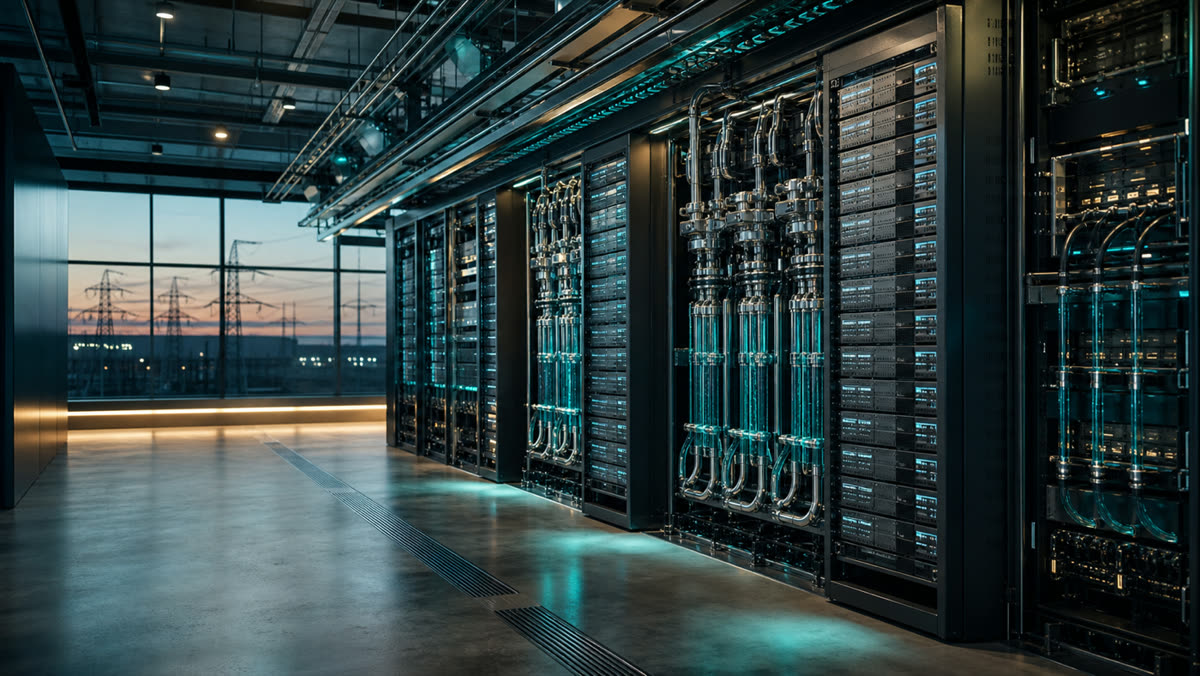
1. Executive brief
This English edition mirrors the same public-source dataset used by the Chinese daily report for 2026-07-17.
- Collection window: 2026-07-16 08:00 北京时间 - 2026-07-17 08:00 北京时间.
- Coverage snapshot: 0 industry items; 0 technology items; 8 paper or white-paper items; 8 video signals.
- Current hot topics: 电力并网与能源约束, AI 芯片供给与交付.
- The heat score is 6/10 and should be read as a source-density signal, not as an investment indicator.
All claims should be verified against the original source links listed at the end of this report.
Academic and Industry Briefs
Papers, videos, industry updates, policy, financing, and projects are compressed into scannable tags with a title, summary, and source link.
Academic
Research papers, methods, research-oriented videos, and academic signals.
How Data Shapes RoPE Frequency Usage: From Positional Scale Matching to L…
Rotary Position Embeddings (RoPE) provide transformers with a fixed grid of positional frequencies, yet trained models use these fr…
Expand
How Data Shapes RoPE Frequency Usage: From Positional Scale Matching to Length Generalization
- Published
- 2026-07-09
- Authors
- Xinyi Wu, Siyuan Liu, Ali Jadbabaie
- Theme
- 算电协同
Abstract
Rotary Position Embeddings (RoPE) provide transformers with a fixed grid of positional frequencies, yet trained models use these frequencies highly non-uniformly. We study what determines this frequency usage and propose a data-centered explanation: RoPE frequencies are selected to match the relative-distance structure of the training data. Viewing each frequency as a positional lens, we formalize a field-resolution tradeoff and show that, for a data-induced dependency profile of width $W$, the optimal frequency scales as $1/W$. This frequency-matching principle explains controlled observations on synthetic and text-based data, and suggests that the mid-low frequency bands observed in language models arise from the multi-scale dependency structure of natural language. We further connect frequency selection to position-interpolation-based length generalization: scaling frequencies down expands the effective field while reducing resolution. This helps when longer-context dependencies are approximate dilations of those seen during training, but can fail when relevant dependencies do not scale with context length. Empirically, we show that natural language exhibits approximate self-similarity across positional scales, explaining why test-time frequency scaling can support long-context generalization. Overall, our results identify a data-driven mechanism behind emergent RoPE frequency usage and show that long-context generalization depends on two forms of scale matching: between learned frequencies and training-time dependencies, and between frequency scaling and how those dependencies extend to longer contexts.
Chinese interpretation
背景:AI 数据中心负载、功率密度和能源约束同步上升,算力负载与电网侧资源的协同调度正在成为智算中心设计的关键变量。问题:论文聚焦现有方案在效率、可靠性或工程协同上的瓶颈。方法:摘要显示作者采用仿真建模和情景分析,把运行负载、冷却/能源系统和基础设施约束放在同一分析框架中。结果:研究重点指向AI 负载波动对电网设备寿命和调频边界的影响。意义:对日报读者而言,它可用于判断智算中心建设是否受电网容量、负载波动和调度机制约束。仍需结合全文实验条件、样本范围和成本假设核验。
Reference
Xinyi Wu, Siyuan Liu, Ali Jadbabaie. How Data Shapes RoPE Frequency Usage: From Positional Scale Matching to Length Generalization[J/OL]. (2026-07-09)[2026-07-17]. http://arxiv.org/abs/2607.07678v1.
Storage as a Transmission Asset (SATA) for Large-Load Congestion Relief
Hyperscale data centers and other large concentrated loads can impose substantial new demand on existing transmission networks. If …
Expand
Storage as a Transmission Asset (SATA) for Large-Load Congestion Relief
- Published
- 2026-07-06
- Authors
- Abanish Tiwari, Chandan Chaudhary, Yansong Pei, Mohammed Ben-Idris, Joydeep Mitra
- Theme
- AI 运维优化
Abstract
Hyperscale data centers and other large concentrated loads can impose substantial new demand on existing transmission networks. If import corridors lack sufficient transfer capability, operators may need to curtail load, delay interconnection, or reinforce the network to maintain reliable service. An energy storage system (ESS) deployed as a storage-as-transmission asset (SATA) offers a non-wires alternative by providing operator-directed support to constrained import corridors. However, the operating-level reliability value of SATA dispatch remains insufficiently quantified. This paper evaluates operator-directed SATA using a day-ahead DC optimal power flow that co-optimizes generation, ESS dispatch, and load curtailment across Monte Carlo scenarios of demand and generator availability. Operating reliability is assessed using expected energy not served (EENS), loss-of-load hours (LOLH), and the conditional value at risk (CVaR) of daily unserved energy. Congestion-price and flow-sensitivity metrics are used to identify the limiting corridor and storage location. The interconnection is then screened to determine whether SATA is suitable, reinforcement is required, or storage would provide little transmission value. Results show that operator-directed SATA reduces average unserved energy, loss-of-load exposure, and tail risk compared with deploying the same ESS for pure arbitrage. These results demonstrate that the operating designation of storage is a primary driver of its transmission value.
Chinese interpretation
背景:AI 数据中心负载、功率密度和能源约束同步上升,AI 运维、负载预测和设施调优正在成为智算中心设计的关键变量。问题:论文聚焦现有方案在效率、可靠性或工程协同上的瓶颈。方法:摘要显示作者采用文献摘要中的模型、实验或案例分析,把运行负载、冷却/能源系统和基础设施约束放在同一分析框架中。结果:研究重点指向能效评价口径、运营指标和优化目标的系统化梳理。意义:对日报读者而言,它可用于判断AI 工具是否能降低运维复杂度并提升可用性。仍需结合全文实验条件、样本范围和成本假设核验。
Reference
Abanish Tiwari, Chandan Chaudhary, Yansong Pei, 等. Storage as a Transmission Asset (SATA) for Large-Load Congestion Relief[J/OL]. (2026-07-06)[2026-07-17]. http://arxiv.org/abs/2607.04545v1.
AI-Driven Thermal Mapping and Management in 3D Integrated Photonic Circui…
Photonic Integrated Circuits (PICs) are advancing high-performance computing, data centers, and sensing, yet three-dimensional (3D)…
Expand
AI-Driven Thermal Mapping and Management in 3D Integrated Photonic Circuits
- Published
- 2026-06-25
- Authors
- Liton Kumar Biswas, Katayoon Yahyaei, Shajib Ghosh, M Shafkat M Khan, Himanandhan Reddy Kottur, Rayhane Ghane-Motlagh, Mahdi Nikdast, Navid Asadizanjani
- Theme
- 热管理与液冷
Abstract
Photonic Integrated Circuits (PICs) are advancing high-performance computing, data centers, and sensing, yet three-dimensional (3D) PICs introduce critical thermal management challenges due to high-density bonding and heterogeneous materials. Traditional methods like thermal microscopes and in-package sensors yield sparse data, limiting full thermal profile visibility. This paper presents a dual-method solution combining an AI-driven thermal modeling framework with a design-based heuristic approach. The AI method integrates sparse sensor data with design layer and density information to predict multilayer temperature variations, while the heuristic approach uses localized material properties, design layout, component geometries, and sensor coordinates to refine thermal estimations in specific regions. A 2D thermal map of a 3D PIC is generated by interpolating sensor data and adjusting for local thermal resistivity using comparative analysis between design regions. The heuristic method complements the AI model, improving estimation accuracy without extensive training data. Together, these methods offer a scalable, accurate solution for real-time thermal mapping and design-time simulation, enabling reliable thermal management in next-generation 3D photonic systems.
Chinese interpretation
背景:AI 数据中心负载、功率密度和能源约束同步上升,液冷、热管理和数据中心能效正在成为智算中心设计的关键变量。问题:论文聚焦现有方案在效率、可靠性或工程协同上的瓶颈。方法:摘要显示作者采用框架构建和频域/系统级分析,把运行负载、冷却/能源系统和基础设施约束放在同一分析框架中。结果:研究重点指向冷却效率、能源利用或运维策略的改进方向。意义:对日报读者而言,它可用于判断液冷方案、热管理路线和高密度部署节奏。仍需结合全文实验条件、样本范围和成本假设核验。
Reference
Liton Kumar Biswas, Katayoon Yahyaei, Shajib Ghosh, 等. AI-Driven Thermal Mapping and Management in 3D Integrated Photonic Circuits[J/OL]. (2026-06-25)[2026-07-17]. http://arxiv.org/abs/2607.07711v1.
WattGPU: Predicting Inference Power and Latency on Unseen GPUs and LLMs
Large Language Model (LLM) inference workloads are a rapidly growing contributor to data center energy consumption. Optimizing thes…
Expand
WattGPU: Predicting Inference Power and Latency on Unseen GPUs and LLMs
- Published
- 2026-07-03
- Authors
- Mauricio Fadel Argerich, Jonathan Fürst, Marta Patiño-Martínez
- Theme
- 芯片与算力
Abstract
Large Language Model (LLM) inference workloads are a rapidly growing contributor to data center energy consumption. Optimizing these deployments requires matching specific LLMs to the most efficient GPUs, but operators currently lack the tools to do so without exhaustively profiling each combination. While some predictive models exist, they still require profiling data and struggle to generalize to hardware unseen during training. To address this, we introduce \textit{WattGPU}, featuring two predictive models for mean GPU power draw and Inter-Token Latency (ITL). Our approach leverages only publicly available LLM metadata and GPU specifications, eliminating the need for hardware access or profiling while enabling generalization to unseen NVIDIA server-grade GPUs and LLMs. We evaluate our models using rigorous leave-one-GPU-out and leave-one-LLM-out cross-validation on a dataset of 42 open-source LLMs (0.1B--27B parameters) and 8 GPUs under both offline and server scenarios. The mean power draw model achieves a median absolute percentage error of $\leq3.4\%$ for offline and $\leq13.5\%$ for server scenarios on unseen GPUs, while the latency model achieves $\leq8.5\%$ in server mode, both maintaining strong GPU ranking correlations for server scenarios (Kendall $τ\geq0.76$). Compared to standard physically grounded baselines -- Load-Scaled Thermal Design Power (TDP) for power draw and roofline for latency -- our models reduce median absolute percentage error by approximately 4$\times$ on unseen LLM-GPU combinations for server scenarios or approximately 2$\times$ for completely unseen GPUs. WattGPU's data and code are publicly available at https://github.com/maufadel/wattgpu.
Chinese interpretation
背景:AI 数据中心负载、功率密度和能源约束同步上升,芯片、服务器和高密度算力部署正在成为智算中心设计的关键变量。问题:论文聚焦现有方案在效率、可靠性或工程协同上的瓶颈。方法:摘要显示作者采用框架构建和频域/系统级分析,把运行负载、冷却/能源系统和基础设施约束放在同一分析框架中。结果:研究重点指向跨地域数据中心负载与电力资源之间的调度关系。意义:对日报读者而言,它可用于判断芯片路线和服务器密度变化如何传导到机房设计。仍需结合全文实验条件、样本范围和成本假设核验。
Reference
Mauricio Fadel Argerich, Jonathan Fürst, Marta Patiño-Martínez. WattGPU: Predicting Inference Power and Latency on Unseen GPUs and LLMs[J/OL]. (2026-07-03)[2026-07-17]. http://arxiv.org/abs/2607.02391v1.
Grid-Interactive Thermal Management of AI Data Centers via Contextual Dis…
Thermal management in AI data centers is increasingly challenged by bursty workloads and uncertain heat generation. To prevent ther…
Expand
Grid-Interactive Thermal Management of AI Data Centers via Contextual Distributionally Robust Optimization
- Published
- 2026-07-01
- Authors
- Jiachen Shen, Jian Shi, Yijie Yang, Chenye Wu, Dan Wang, Ju Bin Song, Zhu Han
- Theme
- 算电协同
Abstract
Thermal management in AI data centers is increasingly challenged by bursty workloads and uncertain heat generation. To prevent thermal violations, existing cooling strategies either enforce conservative, rigid bounds that severely limit grid responsiveness, or rely on forecast-driven controllers that perform poorly under AI workload uncertainty and distribution shifts. To overcome the above challenges, this paper proposes a Contextual Distributionally Robust Optimization (CDRO) framework for grid-interactive cooling control. Unlike standard DRO with fixed ambiguity sets, the proposed approach dynamically adapts the Wasserstein radius using real-time AI and grid context. This safely shrinks uncertainty bounds during stable regimes, unlocking deep demand-side flexibility. Theoretically, we formulate the control as an infinite-dimensional inf-sup problem, derive an exact tractable reformulation for the Wasserstein worst-case expected-cost term, and then derive a tractable conservative deterministic counterpart for the Distributionally Robust Conditional Value at Risk (DR-CVaR) thermal safety constraint. Solved via a scalable nested Alternating Direction Method of Multipliers (ADMM) algorithm, the CDRO controller achieves near-zero thermal violations under extreme workload spikes in high-fidelity EnergyPlus co-simulations. Simultaneously, it reduces the operational cost premium of robustness by approximately 13.7 percentage points relative to standard Min-Max Model Predictive Control (MPC).
Chinese interpretation
背景:AI 数据中心负载、功率密度和能源约束同步上升,算力负载与电网侧资源的协同调度正在成为智算中心设计的关键变量。问题:论文聚焦现有方案在效率、可靠性或工程协同上的瓶颈。方法:摘要显示作者采用建模优化、调度分析或算法评估,把运行负载、冷却/能源系统和基础设施约束放在同一分析框架中。结果:研究重点指向AI 负载波动对电网设备寿命和调频边界的影响。意义:对日报读者而言,它可用于判断智算中心建设是否受电网容量、负载波动和调度机制约束。仍需结合全文实验条件、样本范围和成本假设核验。
Reference
Jiachen Shen, Jian Shi, Yijie Yang, 等. Grid-Interactive Thermal Management of AI Data Centers via Contextual Distributionally Robust Optimization[J/OL]. (2026-07-01)[2026-07-17]. http://arxiv.org/abs/2607.00099v1.
Hot AI in Cold Space: Thermal-Crosstalk-Aware Scheduling for Sustainable …
Terrestrial AI training faces an unsustainable energy and water crisis, positioning Orbital Data Centers (ODCs) as a "zero operatio…
Expand
Hot AI in Cold Space: Thermal-Crosstalk-Aware Scheduling for Sustainable Orbital AI Clusters
- Published
- 2026-06-23
- Authors
- Shuyi Chen, Zhengchang Hua, Nikos Tziritas, Georgios Theodoropoulos
- Theme
- AI 运维优化
Abstract
Terrestrial AI training faces an unsustainable energy and water crisis, positioning Orbital Data Centers (ODCs) as a "zero operational carbon" alternative. However, the sub-$10μ\text{s}$ communication latency required for synchronized scientific workloads, such as distributed Large Language Model (LLM) training, forces ODCs into extreme physical density, triggering a critical "Proximity-Thermal Paradox." As these high-density systems scale into Monolithic Structures or Proximity Swarms, they suffer from intense thermal-fluid crosstalk (heat traps in shared cooling loops) and thermal-radiative crosstalk (mutual heating that blocks deep-space cooling radiators). If left unmitigated, this persistent heat stagnation not only triggers severe thermal throttling that degrades training throughput, but also induces severe thermal fatigue, drastically shortening hardware lifespans and generating premature space e-waste. To make orbital AI truly sustainable, this position paper challenges traditional uniform load-sharing. We propose the Thermal-Aware Heterogeneity Thesis, which treats spatial cooling variances as a primary resource management dimension. Building on this, we introduce Thermal-Load Balancing (TLB), a software framework that dynamically migrates these intensive workloads to the coolest available units based on instantaneous fluid temperatures or absorbed radiation. Our analysis demonstrates that TLB resolves thermal bottlenecks to restore Model Flops Utilization (MFU), while simultaneously reducing physical thermal stress. Extending the operational lifespan of orbital hardware is crucial to amortize the massive embodied carbon of rocket launches, outlining a necessary pathway to scale orbital AI without accelerating e-waste.
Chinese interpretation
背景:AI 数据中心负载、功率密度和能源约束同步上升,AI 运维、负载预测和设施调优正在成为智算中心设计的关键变量。问题:论文聚焦现有方案在效率、可靠性或工程协同上的瓶颈。方法:摘要显示作者采用建模优化、调度分析或算法评估,把运行负载、冷却/能源系统和基础设施约束放在同一分析框架中。结果:研究重点指向AI 负载波动对电网设备寿命和调频边界的影响。意义:对日报读者而言,它可用于判断AI 工具是否能降低运维复杂度并提升可用性。仍需结合全文实验条件、样本范围和成本假设核验。
Reference
Shuyi Chen, Zhengchang Hua, Nikos Tziritas, 等. Hot AI in Cold Space: Thermal-Crosstalk-Aware Scheduling for Sustainable Orbital AI Clusters[J/OL]. (2026-06-23)[2026-07-17]. http://arxiv.org/abs/2606.26150v2.
Financing Artificial Intelligence Infrastructure: Mapping AI Infrastructu…
Artificial intelligence depends on large-scale compute resources and their supporting infrastructure. However, AI governance debate…
Expand
Financing Artificial Intelligence Infrastructure: Mapping AI Infrastructure Investment and Compute Governance Across Africa
- Published
- 2026-06-24
- Authors
- Kai-Hsin Hung, Sumaya Nur Adan, Krupa Suchak, Armita Sadeghian Barzoki, Kofi Yeboah, Mohammad Amir Anwar
- Theme
- 热管理与液冷
Abstract
Artificial intelligence depends on large-scale compute resources and their supporting infrastructure. However, AI governance debates treat compute primarily as a technical input rather than as an outcome of investment, ownership, and financial control. This paper examines AI infrastructure investment flows across Africa through a systematic analysis of 46 publicly announced projects totalling USD $12.7 billion between 2019 and 2025. Using a value chain framework, we analyze who invests in AI-relevant infrastructure and where investments concentrate. Our findings reveal a highly concentrated landscape dominated by global data center operators, hyperscale technology firms, and development finance institutions, clustering in South Africa, Kenya, Nigeria, and Egypt. We introduce asymmetrical interdependence to describe a structural condition in which capital and physical infrastructure account for 73% of total funding while control remains concentrated in the compute layer among a small number of global technology firms. We argue that compute governance must account for capital flows, ownership, and control, not only geographic access, because these dynamics shape AI compute equity. Infrastructure presence is necessary but insufficient for meaningful governance capacity.
Chinese interpretation
背景:AI 数据中心负载、功率密度和能源约束同步上升,液冷、热管理和数据中心能效正在成为智算中心设计的关键变量。问题:论文聚焦现有方案在效率、可靠性或工程协同上的瓶颈。方法:摘要显示作者采用综述归纳和指标比较,把运行负载、冷却/能源系统和基础设施约束放在同一分析框架中。结果:研究重点指向能效评价口径、运营指标和优化目标的系统化梳理。意义:对日报读者而言,它可用于判断液冷方案、热管理路线和高密度部署节奏。仍需结合全文实验条件、样本范围和成本假设核验。
Reference
Kai-Hsin Hung, Sumaya Nur Adan, Krupa Suchak, 等. Financing Artificial Intelligence Infrastructure: Mapping AI Infrastructure Investment and Compute Governance Across Africa[J/OL]. (2026-06-24)[2026-07-17]. http://arxiv.org/abs/2606.28404v1.
AI Data Centers and the Water Use Feedback Loop
AI data centres consume water for cooling, water scarcity constrains siting, and AI tools can improve water system efficiency. Thes…
Expand
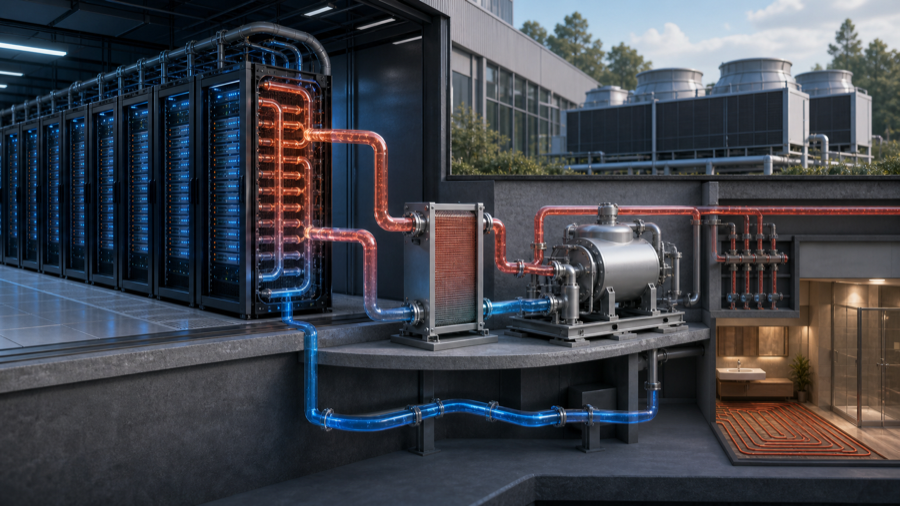
AI Data Centers and the Water Use Feedback Loop
- Published
- 2026-06-20
- Authors
- Basit A. Akinade, Amobichukwu C. Amanambu, Jonathan M. Frame, Shaolei Ren
- Theme
- 热管理与液冷
Abstract
AI data centres consume water for cooling, water scarcity constrains siting, and AI tools can improve water system efficiency. These dynamics are studied separately yet form a feedback loop. This review formalises the Water and AI Feedback Loop, introduces the Water Consumption Impact index to quantify community-scale utility burden, and demonstrates across ten US sites that burden spans three orders of magnitude, from 0.2% to 134% of host capacity.
Chinese interpretation
背景:AI 数据中心负载、功率密度和能源约束同步上升,液冷、热管理和数据中心能效正在成为智算中心设计的关键变量。问题:论文聚焦现有方案在效率、可靠性或工程协同上的瓶颈。方法:摘要显示作者采用综述归纳和指标比较,把运行负载、冷却/能源系统和基础设施约束放在同一分析框架中。结果:研究重点指向冷却效率、能源利用或运维策略的改进方向。意义:对日报读者而言,它可用于判断液冷方案、热管理路线和高密度部署节奏。仍需结合全文实验条件、样本范围和成本假设核验。
Reference
Basit A. Akinade, Amobichukwu C. Amanambu, Jonathan M. Frame, 等. AI Data Centers and the Water Use Feedback Loop[J/OL]. (2026-06-20)[2026-07-17]. http://arxiv.org/abs/2606.21760v1.
Presentation on Latest in Liquid cooling solutions for Data Centers
ET Edge · Query: data center liquid cooling conference presentation。Useful as technical or research context.
Expand
The Hottest Building on Earth? The Hidden Science Behind AI Data Centers …
[ MIDAS ] MTS Lab · Query: data center thermal management seminar。Useful as technical or research context.
Expand
Vertiv Investor Conference 2026 | Data Center Liquid Cooling Production S…
i101 · Query: data center liquid cooling conference presentation。Useful as technical or research context.
Expand
Vertiv Investor Conference 2026 | Data Center Liquid Cooling Production S…
i101 · Query: data center liquid cooling conference presentation。Useful as technical or research context.
Expand
SHORTS - WHY WE BOND (Neutral & Ground) Explained in 3 Minutes
Electrician U · Query: ACM SIGEnergy data center energy talk。Useful as technical or research context.
Expand
电力并网与能源约束
Same-source item from the Chinese report. Verify details against the original linked source: 电力并网与能源约束
展开全文
AI 芯片供给与交付
Same-source item from the Chinese report. Verify details against the original linked source: AI 芯片供给与交付
展开全文
Industry
Industry news, products, policy, financing, projects, and market-oriented videos.
投融资、财报或公司动态:HPCwire 发布相关报道(原文标题:3M and Microsoft Partner on AI Data Cente…
Same-source item from the Chinese report. Verify details against the original linked source: 投融资、财报或公司动态:HPCwire 发布相关报道(原文标题:3M and…
展开全文
Cooling Solutions for Data Centers
Advanced Cooling Technologies Inc. · Query: high performance computing data center cooling workshop。Useful for product, market, or …
Expand
Solidigm | The Physics of 400G Network Buffering and Storage Tuning
Tech Field Day · Query: high performance computing data center cooling workshop。Useful for product, market, or deployment context.
Expand
Testing Station for cooling fluid reservoir caps
MTS — Modern Technology Systems · Query: high performance computing data center cooling workshop。Useful for product, market, or dep…
Expand
产业热度指数 6/10
Same-source item from the Chinese report. Verify details against the original linked source: 产业热度指数 6/10
展开全文
4. Video signals
Presentation on Latest in Liquid cooling solutions for Data Centers
学术会议报告 · ET Edge · Query: data center liquid cooling conference presentation
Open on YouTubeThe Hottest Building on Earth? The Hidden Science Behind AI Data Centers | #CAE #MTS #MidasIT
专家讲座 · [ MIDAS ] MTS Lab · Query: data center thermal management seminar
Open on YouTubeVertiv Investor Conference 2026 | Data Center Liquid Cooling Production Scales For AI Systems
学术会议报告 · i101 · Query: data center liquid cooling conference presentation
Open on YouTubeVertiv Investor Conference 2026 | Data Center Liquid Cooling Production Scales For AI Systems
学术会议报告 · i101 · Query: data center liquid cooling conference presentation
Open on YouTubeCooling Solutions for Data Centers
技术研讨会 · Advanced Cooling Technologies Inc. · Query: high performance computing data center cooling workshop
Open on YouTubeSolidigm | The Physics of 400G Network Buffering and Storage Tuning
技术研讨会 · Tech Field Day · Query: high performance computing data center cooling workshop
Open on YouTubeTesting Station for cooling fluid reservoir caps
技术研讨会 · MTS — Modern Technology Systems · Query: high performance computing data center cooling workshop
Open on YouTubeSHORTS - WHY WE BOND (Neutral & Ground) Explained in 3 Minutes
学术讲座 · Electrician U · Query: ACM SIGEnergy data center energy talk
Open on YouTubeSources
Collection notes
- 公开 RSS/Atom:Data Center Dynamics:检索失败,原因:fetch failed
- 公开 RSS/Atom:The Register:检索失败,原因:fetch failed
- 公开 RSS/Atom:ServeTheHome:检索失败,原因:fetch failed
- 公开 RSS/Atom:Data Center Knowledge:检索失败,原因:fetch failed
- 公开 RSS/Atom:NVIDIA Blog:检索失败,原因:fetch failed
- 论文池:已从本地论文池读取 26 条候选;池更新时间 2026-07-17 07:41。
- YouTube:检索失败,原因:fetch failed
- 视频推荐:当日未形成新候选,按上一日排序池顺延补位。
- When optional automation services are unavailable, this page uses traceable public sources and conservative rule-based summaries only; unverifiable facts are not filled in.