液冷与智算中心日报|2026-10-02
追踪液冷技术、AI 智算中心、数据中心能效、学术论文、产品发布、政策标准、投融资与供应链动态的每日中文报告。
1. 今日一句话总结
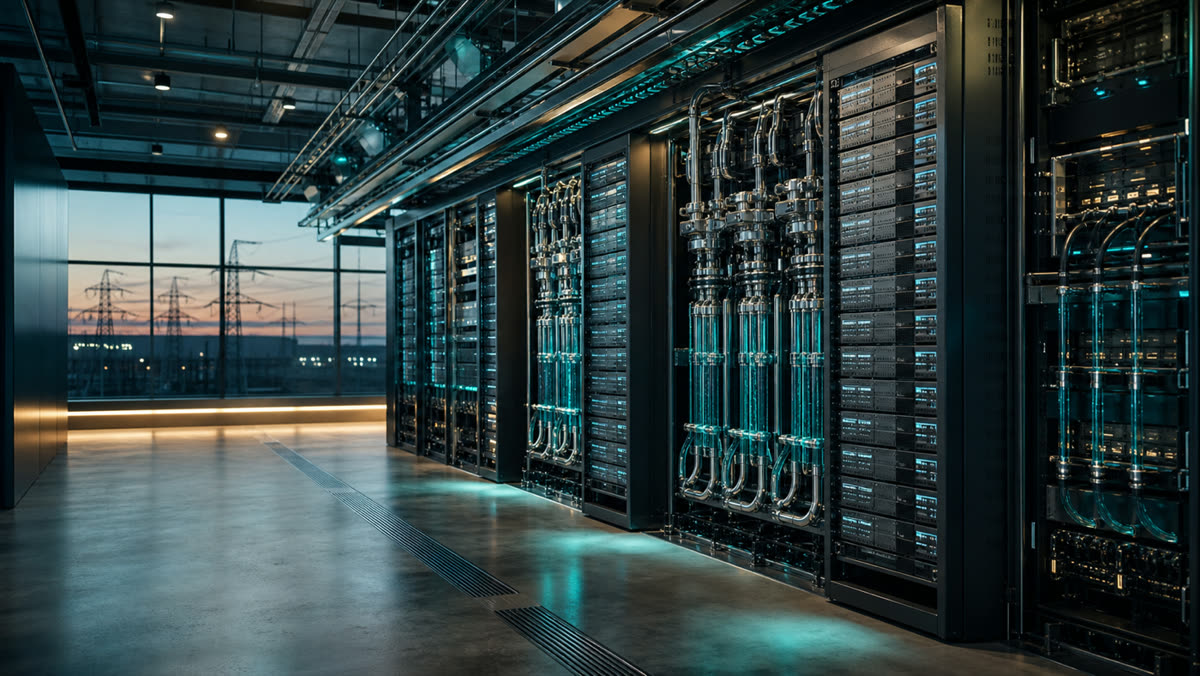
24小时内,资本继续加码智算中心,但电力、审批与能效约束已前置,液冷和算电协同正转为项目准入项。
从公开信号看,资本并未因为约束而降温,资本开支仍向AI数据中心与液冷环节集中,说明头部厂商和基础设施资本仍在前置锁定园区、容量和交付窗口;但与此同时,电力并网与能源约束、AI 芯片供给与交付、液冷路线(冷板/浸没/两相)仍是主线,但基础设施约束已前置,意味着行业竞争的关键变量已不再只是“拿到多少 GPU”,而是“能否把 GPU 放进一个可并网、可散热、可控成本、可持续运行的系统”。技术侧技术侧继续围绕高带宽互连与服务器能效优化,论文侧论文侧继续指向算电协同、液冷优化与能效度量重构,共同指向同一个趋势:单点器件优化的边际价值在下降,网络、供电、储能、液冷和调度软件的系统级协同正在上升为真正的产能约束。对产业链而言,未来更稀缺的不是单一硬件,而是把算力、热管理和能源调度耦合起来的工程交付能力。
学术与产业速览
将论文、视频、产业动态和政策项压缩为可快速扫描的标签;每个标签只保留题目、摘要和来源入口。
学术
论文、研究趋势、学术视频与方法论线索。
Job Class Thermal Intent Aware Liquid Cooling Allocation for AI Data Cent…
GPU-dense AI data centers need to run on liquid cooling as air simply cannot shed the heat at these power densities. Yet the coolin…
展开全文
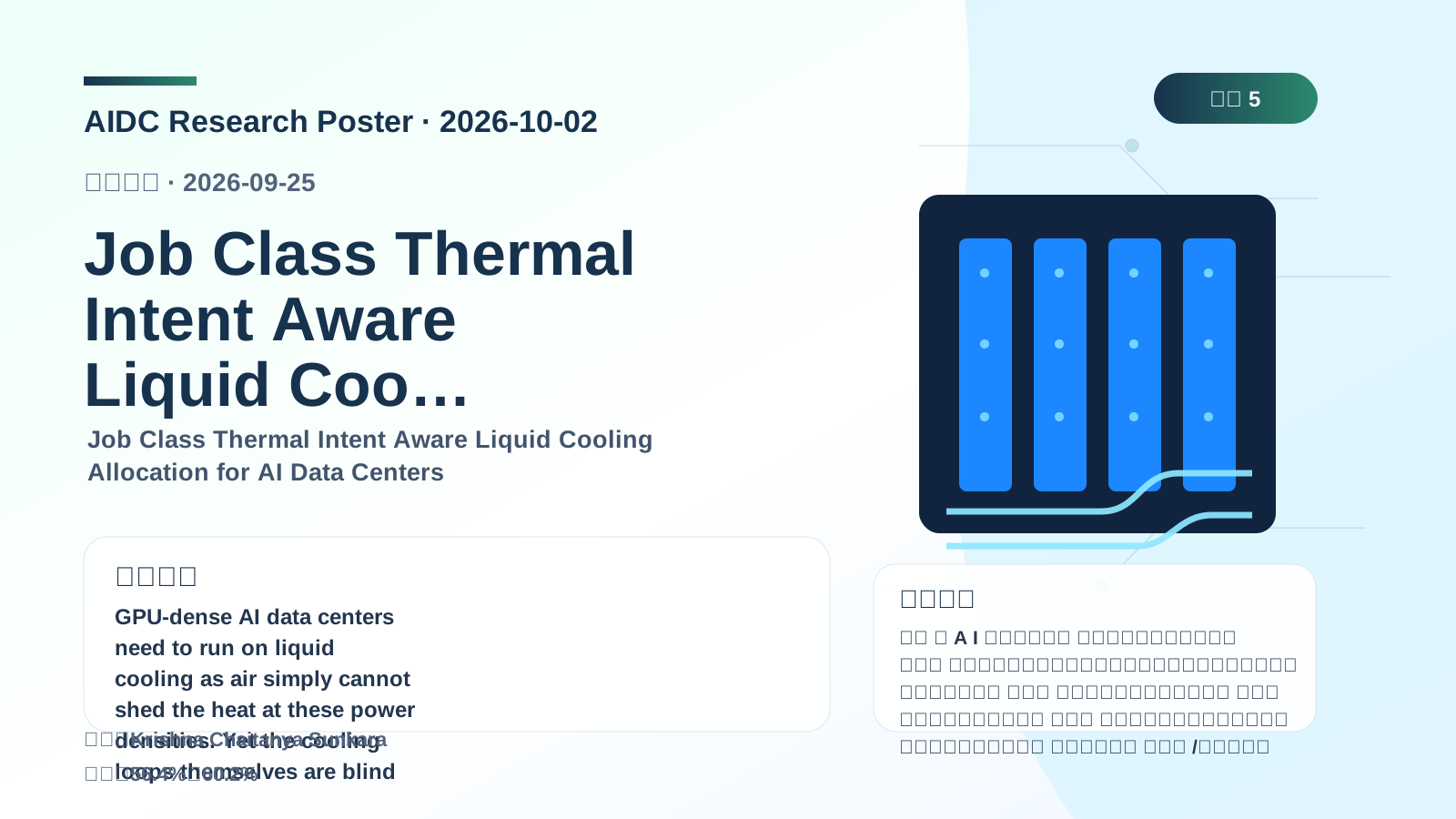
Job Class Thermal Intent Aware Liquid Cooling Allocation for AI Data Centers
- 发布时间
- 2026-09-25
- 作者
- Krishna Chaitanya Sunkara
- 主题
- 算电协同
摘要
GPU-dense AI data centers need to run on liquid cooling as air simply cannot shed the heat at these power densities. Yet the cooling loops themselves are blind to what workloads are about to run; they crank up flow only after a sensor catches a temperature climb, which can take 30 to 50 seconds. We built Job-Class Thermal Intent (JCTI) to close that window. The scheduler already knows a job is coming and what class it belongs to; JCTI feeds that information straight to the cooling controller so it can stage coolant before the heat shows up. We pulled the thermal signatures for each job class out of MLPerf GPU power traces and tuned arrival patterns against Alibaba cluster data. Over 120 paired Monte Carlo trials the numbers come out to 56.4% fewer thermal violations and 60.2% less cumulative overshoot than a straight PI loop. As AI data centers evolving towards gigawatt grid loads with highly fluctuating power swings, thermally-aware scheduling reduces sudden demand and improves load prediction in grid side. Cooling and scheduling have been running as two separate systems for years despite each one knowing something the other needs, JCTI wires them together.
中文解读
背景:AI 数据中心负载、功率密度和能源约束同步上升,算力负载与电网侧资源的协同调度正在成为智算中心设计的关键变量。问题:论文聚焦现有方案在效率、可靠性或工程协同上的瓶颈。方法:摘要显示作者采用建模优化、调度分析或算法评估,把运行负载、冷却/能源系统和基础设施约束放在同一分析框架中。结果:研究重点指向AI 负载波动对电网设备寿命和调频边界的影响。意义:对日报读者而言,它可用于判断智算中心建设是否受电网容量、负载波动和调度机制约束。仍需结合全文实验条件、样本范围和成本假设核验。
参考文献
Krishna Chaitanya Sunkara. Job Class Thermal Intent Aware Liquid Cooling Allocation for AI Data Centers[J/OL]. (2026-09-25)[2026-10-02]. http://arxiv.org/abs/2609.30785v1.
Beyond PUE: A Local Impact Audit Framework for Data Center Environmental …
Standard data center sustainability metrics, including Power Usage Effectiveness (PUE), Water Usage Effectiveness (WUE), and Carbon…
展开全文
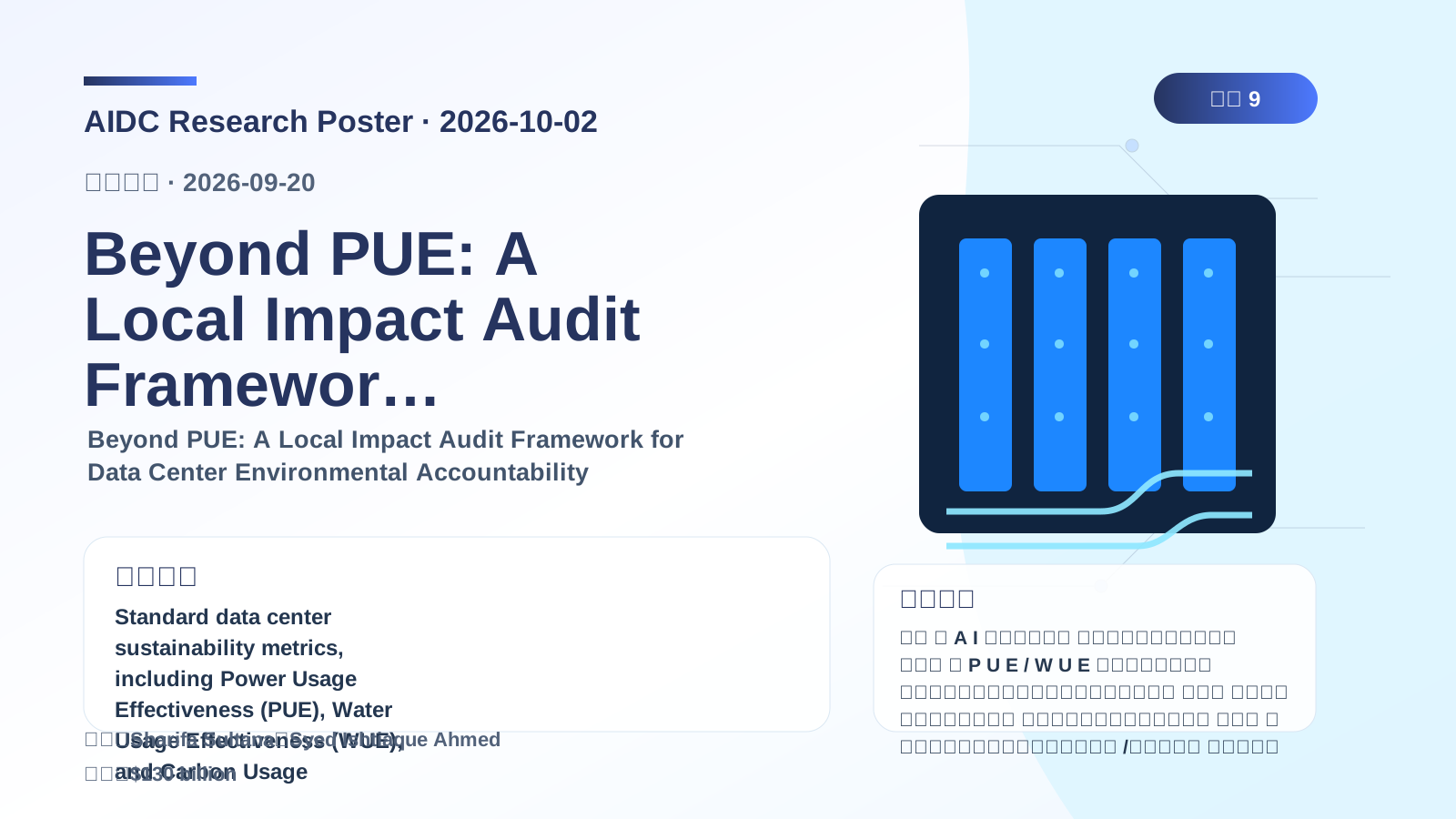
Beyond PUE: A Local Impact Audit Framework for Data Center Environmental Accountability
- 发布时间
- 2026-09-20
- 作者
- Sharifa Sultana、Syed Ishtiaque Ahmed
- 主题
- 能效优化
摘要
Standard data center sustainability metrics, including Power Usage Effectiveness (PUE), Water Usage Effectiveness (WUE), and Carbon Usage Effectiveness (CUE), measure a facility's resource use and emissions intensity, normalized to IT energy use, without directly representing local resource scarcity, infrastructure capacity, or social footprint. This gap has become politically consequential. In the first quarter of 2026 alone, local opposition delayed or canceled roughly $130 billion in projects across the United States, driven overwhelmingly by recurring concerns over water use, power demand, infrastructure capacity, and transparency rather than internal efficiency, matching the total for all of 2025 [11]. We propose a five-category local impact audit framework covering efficiency, water stewardship, carbon and renewables, regulatory compliance, and local disclosure. The framework is designed for recurring quarterly assessment and independent verification against public records. We illustrate its application using publicly available data from three Illinois facilities that are currently at the center of local policy disputes, and we examine the data-access barriers that constrain independent verification. We position this framework as both a research contribution and a practical instrument for county-level policymakers evaluating data center permitting and moratorium decisions.
中文解读
背景:AI 数据中心负载、功率密度和能源约束同步上升,PUE/WUE、能效指标和运营成本控制正在成为智算中心设计的关键变量。问题:论文聚焦现有方案在效率、可靠性或工程协同上的瓶颈。方法:摘要显示作者采用框架构建和频域/系统级分析,把运行负载、冷却/能源系统和基础设施约束放在同一分析框架中。结果:研究重点指向能效评价口径、运营指标和优化目标的系统化梳理。意义:对日报读者而言,它可用于判断不同能效指标是否真实反映节能和成本收益。仍需结合全文实验条件、样本范围和成本假设核验。
参考文献
Sharifa Sultana, Syed Ishtiaque Ahmed. Beyond PUE: A Local Impact Audit Framework for Data Center Environmental Accountability[J/OL]. (2026-09-20)[2026-10-02]. http://arxiv.org/abs/2609.23421v1.
Convective Heat Transfer Optimization for Liquid Cooling Plates Driven by…
The rapid development of liquid-cooled data centers has imposed imperative demands on the performance of liquid cooling plate. The …
展开全文
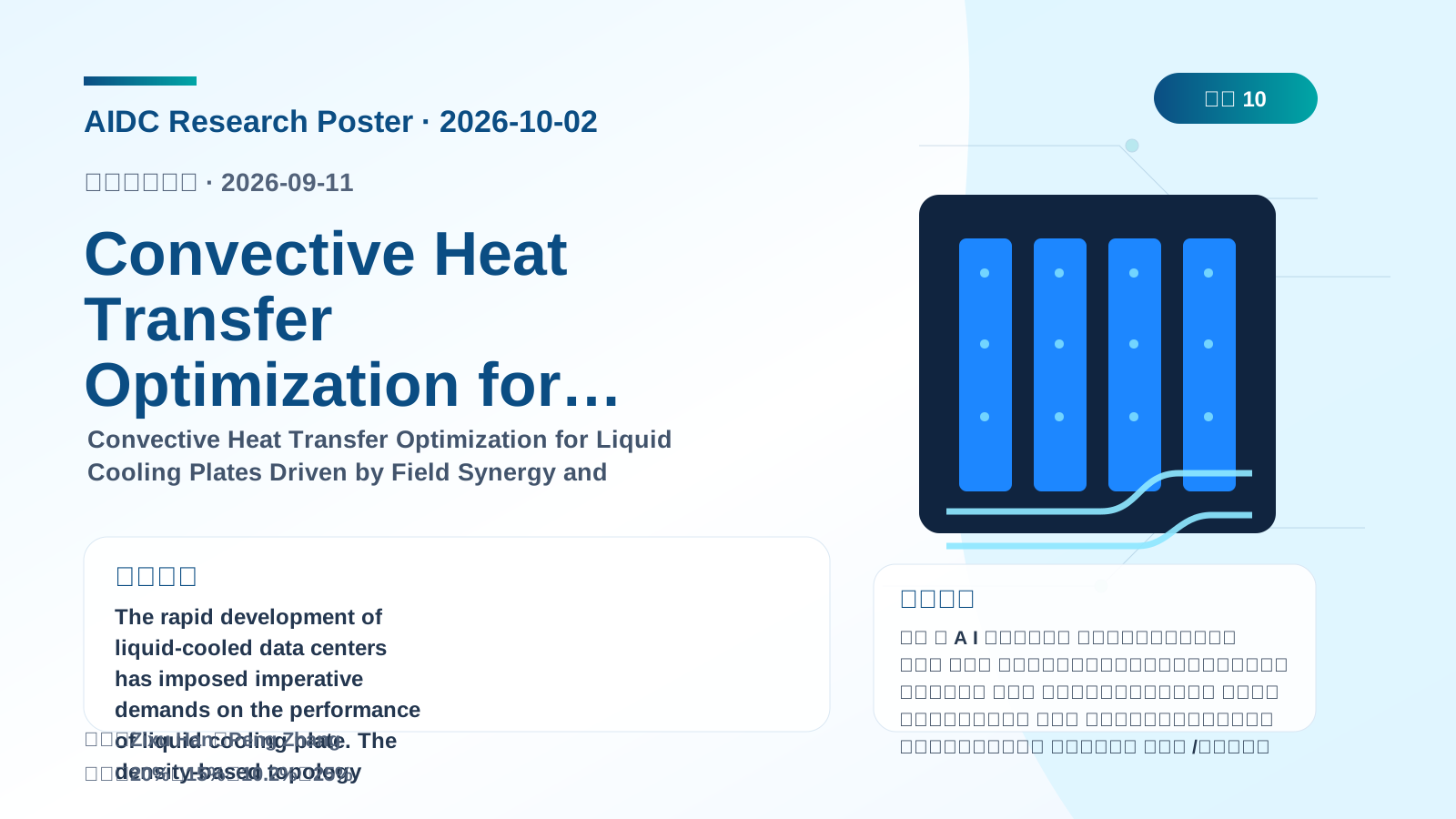
Convective Heat Transfer Optimization for Liquid Cooling Plates Driven by Field Synergy and Fractal Geometry
- 发布时间
- 2026-09-11
- 作者
- Zixu Han、Peng Zhang
- 主题
- 热管理与液冷
摘要
The rapid development of liquid-cooled data centers has imposed imperative demands on the performance of liquid cooling plate. The density-based topology optimization (TO) is an effective approach to resolving the growing thermal-hydraulic performance requirements of liquid cooling plate. However, existing TO methods can hardly optimize convective heat transfer directly which is the intrinsic heat transfer mechanism, due to the highly complex and evolving structural topologies, varying flow and temperature fields, making it extremely challenging to explicitly describe the heat transfer coefficient and heat transfer area during TO process. A convective heat transfer topology optimization (CTO) method is proposed in this study, where the iteratively evolving heat transfer coefficient is explicitly depicted by the field synergy theory in the thermal objective, and directly described by the velocity and temperature fields without relying on specific geometry. Combined with the explicit depiction of heat transfer area by the fractal geometry theory, a CTO framework is built for a direct optimization of convective heat transfer under both the laminar and turbulent flow conditions. The CTO tends to generate more hierarchical and directional structural topologies in optimization results, which is conducive to reducing low-velocity stagnation zones and improving flow direction in branched channels, achieving enhanced synergy and thermal-hydraulic performance in the optimized liquid cooling plates. Compared with the TO results without incorporation of field synergy theory, the CTO can reduce average temperature rise by 20% while improving the Nusselt number by 15% under laminar flow conditions, and reduce maximum temperature rise by 10.2% and pressure drop by 25% under turbulent flow conditions.
中文解读
背景:AI 数据中心负载、功率密度和能源约束同步上升,液冷、热管理和数据中心能效正在成为智算中心设计的关键变量。问题:论文聚焦现有方案在效率、可靠性或工程协同上的瓶颈。方法:摘要显示作者采用建模优化、调度分析或算法评估,把运行负载、冷却/能源系统和基础设施约束放在同一分析框架中。结果:研究重点指向冷却效率、能源利用或运维策略的改进方向。意义:对日报读者而言,它可用于判断液冷方案、热管理路线和高密度部署节奏。仍需结合全文实验条件、样本范围和成本假设核验。
参考文献
Zixu Han, Peng Zhang. Convective Heat Transfer Optimization for Liquid Cooling Plates Driven by Field Synergy and Fractal Geometry[J/OL]. (2026-09-11)[2026-10-02]. http://arxiv.org/abs/2609.12344v1.
ETCInfer: An Energy-efficient Thermal-aware Cooling-joint Scheduler for L…
Large language model (LLM) inference in AI datacenters creates a coupled control problem between GPU serving and facility cooling. …
展开全文
ETCInfer: An Energy-efficient Thermal-aware Cooling-joint Scheduler for LLM Inference in AI Datacenters
- 发布时间
- 2026-09-14
- 作者
- Rui Lu、Rui Ge、Huanghuang Liang、Xiaobo Zhou、Dan Wang
- 主题
- 芯片与算力
摘要
Large language model (LLM) inference in AI datacenters creates a coupled control problem between GPU serving and facility cooling. Raising ambient temperature setpoints can reduce cooling energy and carbon, but also shrinks thermal headroom, induces GPU throttling, and leads to Service-Level-Objective (SLO) violations. In this paper, we study joint cooling--computing control for LLM inference: minimizing per-job GPU-plus-cooling energy while satisfying thermal safety and latency SLO constraints. We present ETCInfer, an energy-efficient, thermal-aware scheduler that selects a pre-job Computer Room Air Conditioner (CRAC) setpoint and adapts per-GPU frequency and micro-batch size during execution. ETCInfer builds compact physics-informed control models by calibrating GPU heat generation, chassis heat dissipation, CRAC power, and prefill/decode latency relations from telemetry. These models estimate hidden thermal states and time-to-throttle, enabling the scheduler to evaluate energy, temperature, and latency before applying an action. We formulate this joint setpoint--frequency--micro-batch control problem as a partially observable Markov decision process and design ETCAdapter, a learning-based controller that minimizes per-job energy under thermal safety and SLO constraints. We implement ETCInfer as a coordination layer over typical inference and cluster management stacks. Evaluation across real-trace simulation and validation experiments shows that ETCInfer reduces total job energy by up to 33.1%, thermal throttle exposure by up to 92.9%, and keeps SLO violation rates below 0.7% even at ambient temperatures up to $48^{\circ}\mathrm{C}$.
中文解读
背景:AI 数据中心负载、功率密度和能源约束同步上升,芯片、服务器和高密度算力部署正在成为智算中心设计的关键变量。问题:论文聚焦现有方案在效率、可靠性或工程协同上的瓶颈。方法:摘要显示作者采用实验验证、原型测试或测量对比,把运行负载、冷却/能源系统和基础设施约束放在同一分析框架中。结果:研究重点指向算力硬件、边缘计算或模型部署对基础设施的牵引。意义:对日报读者而言,它可用于判断芯片路线和服务器密度变化如何传导到机房设计。仍需结合全文实验条件、样本范围和成本假设核验。
参考文献
Rui Lu, Rui Ge, Huanghuang Liang, 等. ETCInfer: An Energy-efficient Thermal-aware Cooling-joint Scheduler for LLM Inference in AI Datacenters[J/OL]. (2026-09-14)[2026-10-02]. http://arxiv.org/abs/2609.15230v1.
Beyond the Last Truffula Tree: SustainAI - A Water-Aware, Closed-Loop Fra…
As artificial intelligence (AI) becomes embedded in everyday life, its environmental footprint, particularly water consumption rema…
展开全文
Beyond the Last Truffula Tree: SustainAI - A Water-Aware, Closed-Loop Framework for Environmentally Accountable AI
- 发布时间
- 2026-09-25
- 作者
- Farnaz Farid、Tashfia Towkee、Sania Nasreen、Sami bin Azad
- 主题
- 算电协同
摘要
As artificial intelligence (AI) becomes embedded in everyday life, its environmental footprint, particularly water consumption remains largely invisible. While energy and carbon impacts are widely recognized, the substantial freshwater demands of data center cooling and electricity generation receive little attention. To address this gap, we introduce SustainAI, a water-aware, closed-loop framework incorporating environmental accountability into AI deployment. SustainAI integrates real-time water metering, a hallucination-aware penalty model, and a water-aware routing algorithm that accounts for regional water stress. Evaluated via Small Language Models (SLMs) extracting health misinformation, results reveal an 11-fold variation in water footprint across geographically distributed data centers (0.0477 mL to 0.5360 mL per inference). Across 1,335 inference runs, the system consumed approximately 399 mL of water but produced only 240 correct outputs, demonstrating that substantial resources are spent on inaccurate responses. Crucially, SustainAI extends beyond technical optimization through a Care by Design lens, framing AI sustainability around relational ethics, regional equity, and ecological stewardship. By combining water monitoring, adaptive accountability, and Care by Design principles, SustainAI provides a practical foundation for integrating ethical care and environmental responsibility into AI infrastructure design and lifecycle management.
中文解读
背景:AI 数据中心负载、功率密度和能源约束同步上升,算力负载与电网侧资源的协同调度正在成为智算中心设计的关键变量。问题:论文聚焦现有方案在效率、可靠性或工程协同上的瓶颈。方法:摘要显示作者采用建模优化、调度分析或算法评估,把运行负载、冷却/能源系统和基础设施约束放在同一分析框架中。结果:研究重点指向冷却效率、能源利用或运维策略的改进方向。意义:对日报读者而言,它可用于判断智算中心建设是否受电网容量、负载波动和调度机制约束。仍需结合全文实验条件、样本范围和成本假设核验。
参考文献
Farnaz Farid, Tashfia Towkee, Sania Nasreen, 等. Beyond the Last Truffula Tree: SustainAI - A Water-Aware, Closed-Loop Framework for Environmentally Accountable AI[J/OL]. (2026-09-25)[2026-10-02]. http://arxiv.org/abs/2609.30747v1.
Could Underwater Data Centers Pose a Risk to AI Treaty Verification?
Proposals for international agreements that limit frontier AI development depend on verification, and a central challenge is detect…
展开全文
Could Underwater Data Centers Pose a Risk to AI Treaty Verification?
- 发布时间
- 2026-09-16
- 作者
- James Teague、Ashmita Rajmohan、Yannick Muehlhaeuser
- 主题
- 热管理与液冷
摘要
Proposals for international agreements that limit frontier AI development depend on verification, and a central challenge is detecting undeclared compute facilities used to evade restrictions. Underwater data centers (UDCs) have been suggested as one such evasion vector, but their feasibility at frontier scale and their detectability have not been seriously assessed. We examine current UDC deployments, evaluate construction and maintenance complexity relative to land-based facilities, and analyse the feasibility of a 100,000 H100-equivalent training run underwater. We find that power delivery and cooling are tractable, but interconnect and the hands-on maintenance that large training runs require are severe obstacles - surmountable only by a well-resourced state actor accepting large cost and schedule penalties, and only where concealment, rather than efficiency, is the objective. We then assess detectability through thermal, acoustic, optical and synthetic-aperture-radar (SAR) surveillance. Thermal detection of an operational pod is unlikely outside shallow, calm water; acoustic detection is marginally more effective, but faces limitations in attribution; and optical/SAR monitoring is most powerful during construction and maintenance, when the pressure-vessel fabrication base and the cable-laying fleet create distinctive signatures for AIS-tracking. We conclude that UDCs are a comparatively unlikely evasion route relative to underground or industrially disguised land-based facilities, but the residual risk is non-zero and warrants operationalising the detection modalities discussed.
中文解读
背景:AI 数据中心负载、功率密度和能源约束同步上升,液冷、热管理和数据中心能效正在成为智算中心设计的关键变量。问题:论文聚焦现有方案在效率、可靠性或工程协同上的瓶颈。方法:摘要显示作者采用文献摘要中的模型、实验或案例分析,把运行负载、冷却/能源系统和基础设施约束放在同一分析框架中。结果:研究重点指向冷却效率、能源利用或运维策略的改进方向。意义:对日报读者而言,它可用于判断液冷方案、热管理路线和高密度部署节奏。仍需结合全文实验条件、样本范围和成本假设核验。
参考文献
James Teague, Ashmita Rajmohan, Yannick Muehlhaeuser. Could Underwater Data Centers Pose a Risk to AI Treaty Verification?[J/OL]. (2026-09-16)[2026-10-02]. http://arxiv.org/abs/2609.18824v1.
Data center cooling choices shift water impacts across the grid: An integ…
Data centers are being developed at an unprecedented pace, yet their energy and water impacts, and the spatial and temporal distrib…
展开全文
Data center cooling choices shift water impacts across the grid: An integrated water-energy model for sustainable data center development
- 发布时间
- 2026-09-22
- 作者
- Garrett Alston、Nancy Love、Rabab Haider
- 主题
- 算电协同
摘要
Data centers are being developed at an unprecedented pace, yet their energy and water impacts, and the spatial and temporal distribution of these impacts, remain poorly characterized. Data centers consume water for cooling (direct) and through electricity generation (indirect). Decisions on siting and cooling technology result in water-energy trade-offs that extend impacts beyond the facility's location. Existing assessment frameworks rely on facility efficiency metrics and average grid water intensity factors, suppressing the temporal impacts of data center load and generation availability. They also attribute indirect consumption to the facility's location rather than to the generators (and corresponding hydrologic regions) that respond to the added load, misattributing spatial impacts. To close this gap, we develop a computational model of the data center-energy-water nexus that links facility cooling and electricity demand with hourly economic dispatch, generator-level water consumption, and monthly subbasin depletion. Built on open-source data, the model resolves where and when water is consumed, and where this consumption compounds existing water risk or creates new risk. Using the model, we study different cooling configurations and proposed developments in the state of Michigan. Air-cooled data centers halve total water consumption relative to evaporative cooling, but increase electricity demand and raise indirect water consumption by one-third, shifting the water footprint from the facility to generators. Mapping these changes to subbasins reveals depletion increases beyond the data center sites, in regions that facility-level reporting may overlook. These results show that data center water and energy impacts cannot be assessed in isolation, motivating the need for integrated modeling to inform siting, design, and reporting practices.
中文解读
背景:AI 数据中心负载、功率密度和能源约束同步上升,算力负载与电网侧资源的协同调度正在成为智算中心设计的关键变量。问题:论文聚焦现有方案在效率、可靠性或工程协同上的瓶颈。方法:摘要显示作者采用框架构建和频域/系统级分析,把运行负载、冷却/能源系统和基础设施约束放在同一分析框架中。结果:研究重点指向AI 负载波动对电网设备寿命和调频边界的影响。意义:对日报读者而言,它可用于判断智算中心建设是否受电网容量、负载波动和调度机制约束。仍需结合全文实验条件、样本范围和成本假设核验。
参考文献
Garrett Alston, Nancy Love, Rabab Haider. Data center cooling choices shift water impacts across the grid: An integrated water-energy model for sustainable data center development[J/OL]. (2026-09-22)[2026-10-02]. http://arxiv.org/abs/2609.25437v1.
Privacy-Preserving Coordinated Operation of Power Grids and AI Data Cente…
The rapid growth of large language model training and serving is driving AI data centers (AIDCs) toward gigawatt scale. Unlike conv…
展开全文
Privacy-Preserving Coordinated Operation of Power Grids and AI Data Centers: A Checkpoint-Aware Three-Phase Scheme
- 发布时间
- 2026-09-22
- 作者
- Ziang Liu、Ruizhang Yang、Xin Cui、Francis Yunhe Hou
- 主题
- 算电协同
摘要
The rapid growth of large language model training and serving is driving AI data centers (AIDCs) toward gigawatt scale. Unlike conventional commercial loads, AIDCs possess significant operational flexibility through dynamic voltage and frequency scaling (DVFS) of training and inference workloads, while periodic model checkpointing can induce abrupt power drops and rebounds that erode operating reserves and increase transmission congestion risks. Coordinating AIDC operation with grid scheduling under these unique operational characteristics is challenging because grid and AIDC operators are generally unwilling to share proprietary data and decision-making authority. This paper proposes a hierarchical privacy-preserving coordinated operation scheme between the power grid and AIDCs to address this gap. The proposed scheme contains three phases. In Phase I, the grid operator computes a certified inner approximation of the AIDCs security region for subsequent coordination. In Phase II, the AIDC operator coordinates training and inference AIDCs to optimize workload allocation within the certified security region and generate power schedules and checkpoint alerts. In Phase III, the grid operator solves a checkpoint-aware two-stage robust optimal power flow (OPF) considering renewable generation and checkpoint uncertainties. By exchanging only compact interface information, the framework preserves the privacy of both grid and AIDCs, avoids frequent iterative communication, and enables secure coordination with guaranteed feasibility. Numerical studies on a modified IEEE 14-bus system and a modified NYISO system demonstrate the effectiveness, robustness, and security of the proposed framework.
中文解读
背景:AI 数据中心负载、功率密度和能源约束同步上升,算力负载与电网侧资源的协同调度正在成为智算中心设计的关键变量。问题:论文聚焦现有方案在效率、可靠性或工程协同上的瓶颈。方法:摘要显示作者采用建模优化、调度分析或算法评估,把运行负载、冷却/能源系统和基础设施约束放在同一分析框架中。结果:研究重点指向AI 负载波动对电网设备寿命和调频边界的影响。意义:对日报读者而言,它可用于判断智算中心建设是否受电网容量、负载波动和调度机制约束。仍需结合全文实验条件、样本范围和成本假设核验。
参考文献
Ziang Liu, Ruizhang Yang, Xin Cui, 等. Privacy-Preserving Coordinated Operation of Power Grids and AI Data Centers: A Checkpoint-Aware Three-Phase Scheme[J/OL]. (2026-09-22)[2026-10-02]. http://arxiv.org/abs/2609.26365v1.
Liquid Cooling in AI Data Center
MEP Academy · 检索词:data center liquid cooling conference presentation。适合作为技术背景或研究趋势补充。
展开全文
Liquid Cooling Technology in Data Centers: How It Supports AI Workloads
Equinix · 检索词:data center liquid cooling conference presentation。适合作为技术背景或研究趋势补充。
展开全文
Panel | Powering AI in Practice | Sustainable Data Centers Symposium
Stanford ENERGY · 检索词:AI data center energy conference keynote。适合作为技术背景或研究趋势补充。
展开全文
Understanding data centre electricity use
IEA Webinars · 检索词:IEEE data center energy efficiency lecture。适合作为技术背景或研究趋势补充。
展开全文
Webinar Recording: Next Generations – Data Center Cooling Technologies
ASHRAE Pyramids Chapter · 检索词:data center liquid cooling conference presentation。适合作为技术背景或研究趋势补充。
展开全文
AI Data Centers Are Outgrowing the Power Grid
The Tech Trek · 检索词:AI datacenter power grid university lecture。适合作为技术背景或研究趋势补充。
展开全文
How AI Data Centers Are Changing the Power Grid Explained Slowly (For Sle…
Quantara Explains · 检索词:AI datacenter power grid university lecture。适合作为技术背景或研究趋势补充。
展开全文
电力并网与能源约束
本期命中 6 条,热度分 18。可作为论文检索、技术路线和后续研究跟踪关键词。
展开全文
AI 芯片供给与交付
本期命中 2 条,热度分 6。可作为论文检索、技术路线和后续研究跟踪关键词。
展开全文
液冷路线(冷板/浸没/两相)
本期命中 2 条,热度分 6。可作为论文检索、技术路线和后续研究跟踪关键词。
展开全文
产业
产业新闻、技术产品、政策标准、投融资、项目和产业视频。
AI, Data Centers & Grid Modernization: Powering the Digital Era Panel | 2…
IEEE Power & Energy Society | Official · 检索词:AI infrastructure datacenter panel discussion。用于补充产业、产品或工程部署观察。
展开全文
产业热度指数 6/10
产业热度指数为 6/10:本期自动化检索记录到 8 条候选条目,指数按候选条目数量、来源可信度和栏目覆盖度保守计算。
展开全文
NVIDIA Blackwell/GB200/GB300
昨日热度高,今日暂无新增高可信条目
展开全文
AI 芯片供给与交付
今日延续上榜
展开全文
智算中心 CapEx/扩建
今日延续上榜
展开全文
4. 最新视频观察
Liquid Cooling in AI Data Center
学术会议报告 · MEP Academy · 检索词:data center liquid cooling conference presentation
在 YouTube 打开Liquid Cooling Technology in Data Centers: How It Supports AI Workloads
学术会议报告 · Equinix · 检索词:data center liquid cooling conference presentation
在 YouTube 打开Panel | Powering AI in Practice | Sustainable Data Centers Symposium
学术会议报告 · Stanford ENERGY · 检索词:AI data center energy conference keynote
在 YouTube 打开AI, Data Centers & Grid Modernization: Powering the Digital Era Panel | 2026 IEEE PES GM Panel
专家圆桌 · IEEE Power & Energy Society | Official · 检索词:AI infrastructure datacenter panel discussion
在 YouTube 打开Understanding data centre electricity use
学术讲座 · IEA Webinars · 检索词:IEEE data center energy efficiency lecture
在 YouTube 打开Webinar Recording: Next Generations – Data Center Cooling Technologies
学术会议报告 · ASHRAE Pyramids Chapter · 检索词:data center liquid cooling conference presentation
在 YouTube 打开AI Data Centers Are Outgrowing the Power Grid
专家讲座 · The Tech Trek · 检索词:AI datacenter power grid university lecture
在 YouTube 打开How AI Data Centers Are Changing the Power Grid Explained Slowly (For Sleep)
专家讲座 · Quantara Explains · 检索词:AI datacenter power grid university lecture
在 YouTube 打开来源链接区
本次检索说明
- 公开 RSS/Atom:Data Center Dynamics:检索失败,原因:fetch failed
- 公开 RSS/Atom:The Register:检索失败,原因:fetch failed
- 公开 RSS/Atom:ServeTheHome:检索失败,原因:fetch failed
- 公开 RSS/Atom:Data Center Knowledge:检索失败,原因:fetch failed
- 公开 RSS/Atom:HPCwire:检索失败,原因:fetch failed
- 公开 RSS/Atom:NVIDIA Blog:检索失败,原因:fetch failed
- 论文池:已从本地论文池读取 17 条候选;池更新时间 2026-10-02 02:38。
- YouTube:检索失败,原因:fetch failed
- 视频推荐:当日未形成新候选,按上一日排序池顺延补位。
- 可选自动化增强服务不可用时,本页仅使用可追溯的公开来源与保守的规则化摘要,不补写无法核验的事实。